Navigating Complex RFP Requirements

When an RFP landed for high-performance drone electronic components under solicitation W911S226U2333, TechWing Precision Electronics—a small business specializing in advanced circuit boards and flight controllers for unmanned aerial systems—faced a moment of truth. The Department of Defense sought NDAA-compliant, open-source FPV drone systems, and this $2.5 million opportunity represented more than just revenue—it was validation that their domestic manufacturing capabilities could compete in the evolving defense landscape.

TechWing’s journey through this RFP illuminates the increasingly complex requirements small manufacturers must navigate in 2025 and beyond. The company had to demonstrate compliance with a web of regulatory frameworks that extended far beyond traditional product specifications.

Compliance Layers: More Than Just Specifications

The solicitation explicitly required adherence to multiple regulatory frameworks:

  • Federal Acquisition Regulation (FAR) 19.5 Total Small Business Set-Aside classification

  • 2020 and 2023 National Defense Authorization Acts (NDAA) compliance

  • American Security Drone Act of 2023 prohibitions on foreign entities

  • Federal Acquisition Security Council restrictions on component sources

TechWing’s technical team spent weeks mapping their supply chain across multiple tiers to ensure no components originated from prohibited foreign entities identified by the Federal Acquisition Security Council. They generated comprehensive Software Bills of Materials (SBOMs) for all embedded firmware, following the minimum requirements established by the National Telecommunications and Information Administration and mandated by Executive Order 14028.

Their cybersecurity documentation had to demonstrate Cybersecurity Maturity Model Certification (CMMC) Level 2 compliance—a requirement that became contractually enforceable with the Department of Defense’s final DFARS rule effective November 10, 2025.

Supply Chain Transparency as a Strategic Differentiator

The company’s supply chain transparency efforts proved particularly challenging yet ultimately differentiating. Defense Federal Acquisition Regulation Supplement (DFARS) clauses required TechWing to provide traceability documentation substantiating material sources and technical conformance. They implemented supply chain mapping technologies that tracked components through multiple tiers:

  • Raw materials from approved suppliers

  • Component manufacturing with quality certifications

  • Assembly processes with material documentation

  • Final product testing and validation

  • Post-delivery compliance verification

This comprehensive supply chain illumination, mandated by recent NDAA provisions, transformed from a compliance burden into a competitive advantage. TechWing’s documented traceability demonstrated maturity and risk management that competitors with less rigorous processes could not match.

Cybersecurity and Compliance Commitments

What TechWing discovered was that winning this RFP wasn’t just about building superior drone electronics—it was about demonstrating comprehensive risk management across multiple dimensions. Their response included:

  • Detailed Plans of Action and Milestones (POA&Ms) for continuous CMMC compliance

  • Annual affirmations of cybersecurity posture with third-party verification

  • Integration with the Supplier Performance Risk System (SPRS) for pre-award validation

  • Remote information wipe capabilities meeting federal data protection standards

  • Multifactor authentication systems for all access points

The Office of Management and Budget’s November 2025 memorandum on UAS procurement added additional layers, requiring encryption of mission data both at rest and in transmission, multifactor authentication for system access, and the ability to wipe federal information remotely.

The Award-Six Months of Preparation Pays Off

After six months of preparation and a meticulously crafted 347-page response that addressed every technical, compliance, and business requirement, TechWing received the contract award. Their win rate climbed, their reputation solidified, and they gained invaluable experience navigating the most stringent procurement requirements in federal contracting. Their story exemplifies how small businesses can compete successfully in the government market by understanding and exceeding compliance expectations.


What is an RFP?

A Request for Proposal (RFP) is a formal document issued by government agencies or private organizations seeking specific products or services from external providers. The RFP serves as a cornerstone of transparent procurement, establishing a structured methodology for collecting detailed proposals from vendors, evaluating them against predetermined criteria, and selecting the provider that best meets the issuer’s technical, operational, and financial requirements.

RFPs ensure competitive bidding without favoritism or bias, upholding procurement integrity through standardized evaluation processes. In government contracting, RFPs are legally mandated for most procurement activities, subject to complex regulations including the Federal Acquisition Regulation (FAR) and agency-specific supplements.

Where RFPs Are Used

Federal, state, and local agencies use RFPs for procurements spanning diverse sectors and service categories:

  • Information technology systems and software solutions

  • Professional services (consulting, engineering, legal)

  • Complex equipment acquisitions and hardware

  • Infrastructure projects and construction

  • Maintenance and support services

  • Specialized manufacturing and production

Key RFP Response Elements

The RFP document typically comprises several critical elements:

  • Statement of Work (SOW) or Performance Work Statement (PWS) defining deliverables and objectives

  • Instructions to Offerors explaining submission requirements and formatting

  • Evaluation Criteria outlining how proposals will be scored

  • Budget Constraints or cost parameters

  • Submission Deadlines with associated milestones

  • Contract Line Item Numbers (CLINs) breaking down the contract into specific items with quantities and pricing

  • Terms and Conditions covering compliance with laws, regulations, and special requirements

What is an RFP Response?

An RFP response is a comprehensive proposal document submitted by vendors competing for contract awards, demonstrating how their solution addresses the issuer’s requirements while showcasing qualifications, experience, and unique value propositions. The response serves dual purposes: proving compliance with mandatory requirements and persuading evaluators that the vendor represents the optimal choice among competitors.

Response Structure and Key Sections

Effective RFP responses follow a structured format that mirrors the issuer’s priorities and evaluation criteria:

  • Cover Letter establishing human connection and expressing genuine partnership interest

  • Executive Summary synthesizing crucial proposal aspects without requiring full document review

  • Technical Approach detailing methodologies, processes, and technologies for fulfilling requirements

  • Management Plan articulating project governance, team structure, and communication protocols

  • Past Performance showcasing relevant experience through case studies with quantifiable results

  • Pricing Proposal outlining cost structures with detailed breakdowns

  • Compliance Matrices mapping every requirement to corresponding response sections

Critical Response Requirements

The response must address both functional and non-functional dimensions. Successful proposals balance:

  • Functional requirements: What the system does and specific deliverables

  • Non-functional requirements: How the system performs in terms of security, reliability, scalability, and usability

  • Substantiation: Every claim backed by proof points—metrics, standards certifications, or customer testimonials

  • Transparency: Clear disclosure regarding any limitations or requirements that cannot be fully met

  • Mapping: Direct alignment between RFP specifications and proposed solutions using compliance matrices and tables

What Makes an Exceptional RFP Response?

Exceptional RFP responses transcend mere compliance, transforming technical documentation into compelling narratives that position the vendor as the singular solution to the client’s challenges.

Characteristics of Winning Proposals

Outstanding responses demonstrate several distinguishing features that separate them from competent but forgettable submissions.

Personalization and Context Understanding

Generic, boilerplate content signals disinterest and fails to resonate with evaluation teams. Exceptional responses demonstrate deep understanding of:

  • The issuer’s industry and operational landscape

  • Specific challenges keeping decision-makers engaged

  • Strategic priorities and organizational objectives

  • Regulatory environment and compliance pressures

When evaluators encounter their specific terminology, recognize their unique challenges articulated accurately, and encounter solutions tailored to their context rather than standardized offerings, engagement intensifies and confidence builds.

Win Themes and Strategic Messaging

Win themes—recurring messages that reinforce the vendor’s competitive advantages—must be strategically embedded throughout the proposal. Effective themes directly address the issuer’s hot button issues:

  • For agencies struggling with deadline compliance: Emphasize proven on-time delivery, robust project management, contingency planning

  • For organizations battling budget overruns: Highlight fixed-price options, transparent cost controls, historical performance within constraints

  • For buyers concerned with cybersecurity: Feature CMMC certifications, security architecture expertise, incident response capabilities

  • For clients valuing innovation: Showcase proprietary methodologies, technical breakthroughs, intellectual property

Clarity, Readability, and Visual Communication

Evaluators reviewing dozens or hundreds of proposals appreciate concise, skimmable formatting featuring:

  • Strategic use of headings, subheadings, and bullet points

  • Tables and matrices for complex comparisons

  • Visual elements (charts, diagrams, infographics) transforming text-heavy content

  • Accessible explanations of technical concepts without excessive jargon unless industry-specific terminology adds precision

Proof and Precision

Exceptional responses include specific, measurable outcomes from previous engagements such as:

  • “Implemented cybersecurity framework that achieved CMMC Level 2 certification within four months, enabling client to compete for $50 million in defense contracts”

  • “Reduced project delivery timelines by 35% through proprietary methodology, saving client $2.1 million annually”

  • “Managed supply chain for 47 component suppliers across 12 countries with zero compliance violations”

Supporting elements include:

  • Customer success stories and case studies

  • Independently verifiable references

  • Quantified results providing tangible evidence

  • Performance metrics exceeding industry standards

Addressing Evaluation Criteria Explicitly

Evaluators assign scores according to specific factors detailed in the RFP—technical approach, relevant experience, cost, timeline, innovation. Exceptional responses demonstrate alignment by:

  • Creating evaluation matrices within the proposal itself

  • Mapping each requirement to corresponding response sections

  • Showing where responses meet minimum standards

  • Highlighting areas where proposals exceed expectations

Anticipating and Addressing Concerns

Preemptively addressing potential objections strengthens credibility. Consider these scenarios:

  • Smaller vendor competing against enterprises: Acknowledge size while emphasizing agility, personalized service, and senior-level attention

  • New technology or unproven approach: Provide pilot programs, phased implementations, or warranty guarantees reducing perceived risk

  • Solution requires client resources: Transparently outline requirements while demonstrating facilitation strategies and training support

  • Incumbent competitor advantage: Focus on innovation, cost improvements, and service enhancements differentiated from status quo

How We Can Help

Navigating the complexities of modern RFP responses—whether for federal, state, local government contracts or private sector opportunities—requires specialized expertise, strategic insight, and meticulous attention to detail. Organizations of all sizes face resource constraints, tight deadlines, and the perpetual challenge of standing out in competitive fields where every submission must demonstrate compliance, capability, and compelling value.

Comprehensive RFP Services

Our approach supports businesses through every stage of the proposal lifecycle:

Strategic Qualification and Go/No-Go Analysis

  • Conduct thorough evaluations of opportunity alignment with core competencies

  • Assess competitive positioning and realistic win probabilities

  • Prevent wasted effort on low-probability pursuits

  • Allocate resources strategically to high-opportunity engagements

Detailed RFP Analysis and Compliance

  • Extract every requirement, evaluation criterion, and submission guideline

  • Create comprehensive compliance matrices ensuring nothing falls through the cracks

  • Map technical, management, and cost requirements to your capabilities

  • Identify gaps early and develop persuasive strategies to address them

Narrative Development and Win Themes

  • Craft compelling stories that transform technical specifications into persuasive narratives

  • Develop customized win themes aligned with unique differentiators and client pain points

  • Integrate proof points—quantified outcomes, customer testimonials, certifications, recognition

  • Substantiate claims building evaluator confidence

Regulatory Compliance Expertise

For government contracts, specialized expertise includes:

  • FARS and DFARS compliance assurance

  • CMMC cybersecurity requirements and documentation

  • SBOM (Software Bill of Materials) development and validation

  • Supply chain transparency and traceability demonstration

  • Federal acquisition regulation navigation including FAR Overhaul and class deviations

Project Management and Coordination

  • Manage subject matter expert contributions and scheduling

  • Maintain version control and version history

  • Meet internal and external deadlines reliably

  • Ensure organizational alignment and stakeholder engagement

Technical Proposal Development

  • Develop methodology descriptions addressing each requirement

  • Create realistic implementation plans with detailed timelines

  • Incorporate risk mitigation strategies and quality assurance frameworks

  • Define performance metrics aligned with client objectives

Management and Pricing Proposals

  • Articulate project governance structures and reporting relationships

  • Identify key personnel with roles and qualifications

  • Describe communication protocols and escalation procedures

  • Develop competitive, well-justified cost structures strategically positioned for value

Quality Control and Pre-Submission Review

  • Conduct rigorous compliance checks using detailed checklists

  • Verify formatting requirements, required forms, and submission specifications

  • Perform red team reviews from the buyer’s perspective

  • Identify weaknesses and improvement opportunities before submission

Scalable Engagement Models

We serve organizations across the size spectrum:

  • Small businesses competing for their first government contracts

  • Established enterprises pursuing nine-figure procurements

  • Mid-market companies scaling proposal capabilities

  • Specialized service providers addressing niche markets

Our scalable approach adapts to your resources, timeline, and complexity while maintaining uncompromising quality standards.

Engagement Options

Full-Service Proposal Development
Complete management from analysis through submission

Targeted Support for Specific Sections
Focused assistance on technical approach, management plan, or pricing

Compliance Reviews
Specialized assessment against RFP requirements and regulatory standards

Strategic Coaching
Training and guidance for internal teams to build proposal capabilities

Our mission is singular: helping you win by transforming RFP requirements into winning proposals that showcase your capabilities, address evaluator priorities, and position your organization as the optimal choice.

Ready to Win Your Next RFP?

Don’t navigate complex procurement requirements alone. Whether you’re a small business pursuing your first government contract or an established enterprise competing for major awards, we provide the expertise, strategic insight, and meticulous execution that turn opportunities into wins.

Contact Us Today

WCAG Compliance Is Your Competitive Edge 

On April 24, 2026, thousands of government websites and documentation systems will face a moment of truth: Will they pass the WCAG 2.1 Level AA accessibility test—or face federal penalties up to $150,000 per violation?

WCAG compliance isn’t just about avoiding fines. It’s about positioning your organization  to take pursue opportunities that non-compliant ones cannot.

If you’re an aerospace supplier, small aviation manufacturer, or other type of company pursuing government contracts, the April 2026 deadline is a competitive inflection point that will separate market leaders from those left behind.

Let me show you why—and more importantly, how–to turn this deadline to your advantage.

What Is WCAG 2.1 Level AA (And Why Should You Care)?

Web Content Accessibility Guidelines (WCAG) 2.1 Level AA represents the international standard for making digital content accessible to people with disabilities. Think of it as the building code for digital documentation—a set of technical criteria ensuring that everyone, regardless of ability, can perceive, understand, navigate, and interact with your content.

The guidelines are built on four principles (memorably abbreviated as POUR):

  • Perceivable: Information must be presented in ways users can perceive (not invisible to all senses). This means providing alternative text for images, captions for videos, and sufficient color contrast between text and backgrounds.
  • Operable: Interface components must be operable by everyone. Users should be able to navigate your documentation using only a keyboard, not just a mouse. Interactive elements need to be large enough for users with motor impairments to activate.
  • Understandable: Information and operation of the interface must be understandable. Content should be readable, predictable in behavior, and include input assistance for forms and interactive elements.
  • Robust: Content must be robust enough to work with current and future assistive technologies,
    including screen readers, magnification software, and alternative input devices.

Level AA is the sweet spot—more comprehensive than Level A (basic accessibility) but more achievable than Level AAA (which includes requirements like sign language interpretation for all audio content).


The Real Cost of Inaccessibility (Not What You Think)

Most articles about WCAG compliance lead with fear: lawsuits, fines, penalties. And yes, those risks are real. Domino’s Pizza learned this the hard way when the Supreme Court declined to hear their appeal of an accessibility lawsuit, ultimately costing them hundreds of thousands in legal fees and settlements. The number of digital accessibility lawsuits has grown exponentially—over 4,500 federal lawsuits filed in 2023 alone.

But legal risk is actually the smallest cost of inaccessibility. The bigger costs are invisible—opportunities you never see because customers can’t access your documentation:


  • Lost Government Contracts: Starting April 24, 2026, state and local governments with populations over 50,000 must ensure all web content and mobile apps meet WCAG 2.1 Level AA standards. Smaller governments and special districts have until April 26, 2027. Federal agencies already operate under accessibility requirements.
  • Invisible Market Exclusion: The disability community represents 1.3 billion people globally—that’s about 16% of the world’s population. In the United States alone, people with disabilities control over $490 billion in disposable income. When your documentation is inaccessible, you’re not just failing to serve these customers—you’re actively excluding them from becoming customers in the first place.
  • Competitive Disadvantage: Gartner predicts that by 2026, digital products in full WCAG compliance will outperform competitors by 50%. That’s not hyperbole—it’s a reflection of accessibility’s ripple effects across customer satisfaction, search rankings, and market reach.
  • SEO Penalties: Here’s a hidden cost most people miss: inaccessible documentation ranks lower in search results. Why? Because the same features that make content accessible to people with disabilities—clear heading structures, descriptive links, semantic HTML, alt text for images—are precisely what search engines use to understand and rank your content. When you optimize for accessibility, you automatically optimize for search engines


What does this mean for contractors and suppliers? If your technical documentation, product manuals, or online resources aren’t WCAG compliant, you’re potentially ineligible for government contracts. Even if your primary deliverable isn’t documentation, the inability to provide accessible product information, maintenance guides, or training materials can disqualify your entire proposal.

The April 2026 Deadline: Who Must Comply and Why It Affects Private Companies, Too

Mandatory Compliance (April 26, 2027):

  • Smaller state and local government entities

  • Special districts regardless of population

Already Under Accessibility Requirements:

  • Federal agencies and departments (Section 508 compliance)

  • Educational institutions receiving federal funding

  • Healthcare organizations (especially those serving Medicare/Medicaid patients)

Even if you’re a private company not directly subject to these deadlines, they affect you if you serve these markets.

Consider these scenarios:

  • Aerospace Supplier Scenario: You manufacture avionics components for small aircraft. Your primary customers include flight schools (often public institutions or federally funded), aircraft maintenance facilities serving government fleets, and aerospace contractors working on military programs. When these customers procure your products, they need accessible technical documentation to comply with their own accessibility obligations. If you can’t provide WCAG-compliant maintenance manuals, installation guides, and product specifications, you’ve created a compliance problem for your customer—and they’ll find a supplier who hasn’t.
  • Government Contractor Scenario: You’re responding to an RFP for a defense contract. The RFP requires delivery of technical data packages, operating manuals, and training materials. Buried in the contract requirements is a clause requiring all deliverables meet Section 508 accessibility standards (which align with WCAG 2.1 Level AA). If you can’t certify compliance, your proposal may be deemed non-responsive—eliminated before technical evaluation even begins.
  • The Private Sector Ripple Effect: Even companies with no government connections are affected. Major corporations including Microsoft, Amazon, and Google now require accessibility compliance from their suppliers. Industry-specific supply chain requirements increasingly include accessibility standards. And consumer expectations are rising—72% of customers report they would switch to a competitor offering better accessibility.

The Competitive Advantages of WCAG Compliance Nobody Talks About

Flip the script: what if instead of viewing WCAG compliance as a cost center, you positioned it as a strategic weapon?

  • Market Differentiation: In most industries, accessibility compliance rates hover around 3-5%. That means 95-97% of your competitors have inaccessible digital content. When you achieve WCAG 2.1 Level AA compliance and publicize it (through accessibility statements, certifications, and marketing), you immediately differentiate from the vast majority of competitors. For procurement officers evaluating vendors, accessibility compliance signals professionalism, attention to detail, and lower risk.
  • Revenue Growth: The numbers don’t lie. Companies transitioning to accessible websites experience 25-70% sales increases. Why such dramatic growth? First, you’re reaching previously excluded customers—the 1.3 billion people with disabilities represent massive untapped market potential. Second, accessibility improvements enhance usability for everyone, not just users with disabilities. Clear navigation benefits users on mobile devices. Keyboard shortcuts help power users. Transcripts for videos serve people in sound-sensitive environments. Better accessibility means better user experience universally.
  • One tech company we assessed found that after implementing WCAG 2.1 AA compliance, their documentation engagement metrics improved across the board: 35% increase in time spent on technical documentation pages, 42% reduction in support tickets related to “can’t find information” issues, and measurable improvements in customer satisfaction scores. These improvements weren’t just among users with disabilities—they benefited everyone.
  • Government Contract Competitive Advantage: Here’s an angle most companies miss: in many government RFPs, accessibility compliance isn’t just a pass/fail requirement—it’s often worth evaluation points. While specific weightings vary by agency and contract type, we’ve seen RFPs where accessibility capabilities and past performance contribute to 10-15% of the total technical evaluation score. When you can demonstrate mature accessibility practices, compliant past performance, and systematic processes for ensuring ongoing compliance, you’re not just meeting a requirement—you’re earning competitive points.
  • Insurance Against Future Requirements: Accessibility requirements are expanding, not contracting. The European Accessibility Act takes effect in June 2025, requiring accessibility for a broad range of products and services in EU markets. Similar legislation is advancing in other jurisdictions. By achieving WCAG 2.1 Level AA compliance now, you’re future-proofing against increasingly stringent global requirements.
  • Talent Attraction and Retention: Here’s an unexpected benefit: companies with strong accessibility commitments attract better talent. Technical writers, engineers, and product managers increasingly evaluate potential employers based on values and social impact. A genuine commitment to accessibility signals that your organization values inclusion and excellence—traits that appeal to top performers.

The Bottom Line: WCAG Compliance as a Strategic Advantage

As we approach the April 2026 deadline, accessibility compliance is transitioning from “nice to have” to “must have” for companies serving government markets. But the real opportunity isn’t avoiding penalties—it’s capturing competitive advantages your competitors haven’t recognized yet.

Companies that view accessibility as a compliance burden will do the minimum required. Companies that recognize accessibility as a strategic weapon will invest ahead of requirements, position accessibility as a differentiator, and capture market opportunities others miss.

Ready to Turn Accessibility into Your Competitive Advantage?

We help anyone who is subject to the requirements of WCAG 2.1.  We transform accessibility compliance  into strategic advantage.

Request Your Free WCAG Accessibility Assessment 

Our complimentary assessment identifies gaps, prioritizes improvements, and provides a realistic roadmap for achieving compliance. No obligation. No sales pressure. Just expert insights you can use.


Get Your Free wcag 2.1 Assessment

April is coming fast.  Start your WCAG transformation now

CONTACT US


Chaos to Compliance


In the high-stakes world of medical device manufacturing, a brilliant product is not enough. You can build a system that detects cancer cells with unprecedented accuracy, but if you cannot prove consistent, validated performance to the FDA, you do not have a product—you have an expensive paperweight.

We recently partnered with a diagnostic innovator facing this exact challenge. They had developed a breakthrough “partially automated” cytology platform that bridged the gap between manual lab work and full automation. The engineering was sound. The science was validated.

But they faced a critical hurdle: The Documentation Fog.

Because the device relied on human operators to achieve machine-level precision, the regulatory burden was immense. How do you prove to the FDA that a manual process will yield the exact same “monolayer slide” every single time, across different labs and different operators?

The answer wasn’t just in the engineering. It was in the User Manuals, the Compliance Narrative, and the Technical Storytelling.

Project at a Glance: NexGene Diagnostics

FDA 510(k) Clearance, Case Study, Technical Writing, Regulatory Documentation, Medical Device, User Manuals, Compliance Documentation, White Paper, Quality Management

The Fix: Turning “Steps” into “Controls”


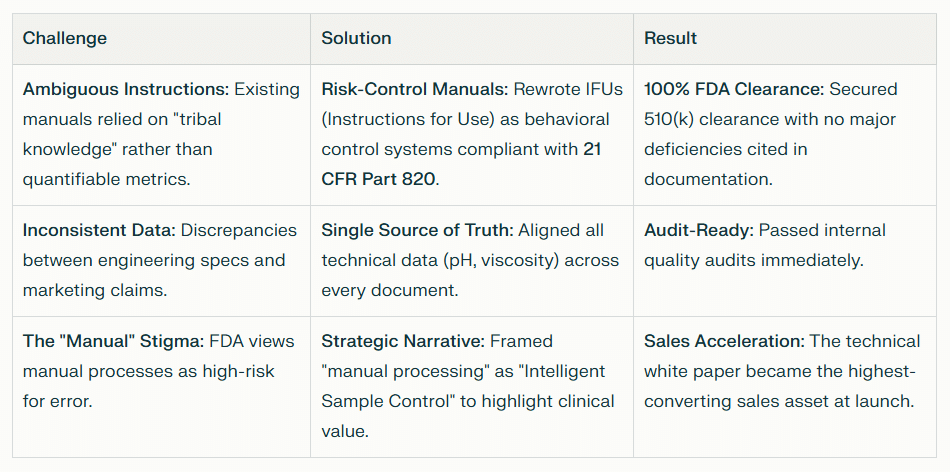
When we audited the project, we found the “Chaos” wasn’t in the hardware—it was in the information architecture. The existing documentation treated critical tasks as suggestions rather than mandates.

To bridge the gap from Chaos to Compliance, we implemented a three-tiered documentation strategy:

1. The User Manual as a Validation Tool
Standard manuals just list steps (e.g., “Mix the reagent”). For FDA submission, this is insufficient. We rewrote the user documentation to function as a behavioral control.

Precision Language: We replaced vague instructions with quantifiable metrics. “Mix well” became “Invert the vial 5 times to ensure viscosity specifications are met.”

Visual Validation: We integrated diagrams that showed users exactly what “success” looked like (a true monolayer) and what “failure” looked like (obscuring artifacts).

The Result: The manual didn’t just teach usage; it enforced the Quality by Design (QbD) principles the FDA demands.

2. The Compliance Narrative
A 510(k) submission is essentially a legal argument. You must prove “Substantial Equivalence” to a predicate device while highlighting your innovation. We crafted a narrative that turned the device’s potential weakness—its “manual” aspect—into its greatest strength.

We documented how the lack of full automation actually allowed for “Intelligent Sample Processing”—a feature that reduces glandular cell loss. This wasn’t marketing fluff; it was a technical argument backed by data, positioned perfectly for a regulatory reviewer.

3. The “Single Source of Truth”
Inconsistencies kill submissions. A marketing white paper cannot claim “100% cell retention” if the validation data shows 98%. We aligned every piece of collateral—from the Instruction for Use (IFU) to the all of the supporting documentation—to ensure specific technical values were identical.


The Lesson for Your Product

Whether you are building a SaaS platform, an aerospace component, or a medical device, the principle holds true: Ambiguity is risk.

Great documentation does more than describe your product—it validates it. It turns the chaos of “how does this work?” into the compliance of “this works exactly as intended, every time.”

Innovation Meets Regulation


NexGene developed VisiLayer®, a breakthrough “partially automated” cytology reagent system. While the technology offered superior glandular cell retention compared to fully automated competitors, its reliance on manual processing created a significant regulatory hurdle. To achieve FDA 510(k) clearance, NexGene needed to prove that their manual process was not just “flexible,” but controllable, repeatable, and validated. What we provided:


  • White Papers
  • Case Studies
  • Product Manuals
  • Installation Manuals
  • Instruction Manuals
  • User Manuals
  • Training Manuals
  • Regulatory Documentation
  • Compliance Documentation
  • Documentation for Medical Device Submissions

Need to turn your technical complexity into regulatory compliance?

Professional Documentation Solutions: The Right Approach for Any Organization

Businesses of any size across sectors such as aerospace, medical device, pharmaceutical, financial services, and industrial areas face increasing demands for accurate, compliance-ready documentation. Some require structured content; others need traditional formats. Small and mid-size businesses struggle to afford engaging, unambiguous product manuals, user guides, installation instructions, or operational documentation that can make or break exceptional products and services.

But enterprise-grade documentation software isn’t always realistic—or necessary. 

We partner with organizations to assess your specific documentation challenges—regulatory mandates, compliance gaps, customer expectations, internal team capabilities—and design solutions using tools you already own or can affordably adopt. We then create compliant, professional content using accessible platforms, provide the training and ongoing support you need, and enable your team to maintain documentation independently without permanent consulting dependency.  Of course, if you would rather that we manage it, we are happy to do that.

Whether preparing for audits, meeting compliance mandates, creating technical manuals, or moving to professional documentation systems, we welcome project inquiries, RFP requests, and questions about our approach.

Contact Us About Your Documentation Project

The Real Documentation Challenge: Compliance Architecture, Not Software

In a world of hybrid work and rapid regulatory changes, most organizations use accessible, familiar tools for documentation—Microsoft Word, PDF documents, SharePoint, Google Drive. While specialized content management systems are ideal in theory, the realities of procurement constraints, budget limits, and team skillsets mean most organizations must work with what they already own.  We work with whatever content management system you own or want to use.  

Here’s the critical distinction: Industry standards specify what must be documented—not what software to use. Boeing doesn’t mandate proprietary tools. The FDA doesn’t require specific authoring platforms. 21 CFR Part 211 (pharmaceutical) doesn’t prescribe software. GLBA (financial services) doesn’t demand particular systems.

Compliance comes from documented content and demonstrated process—not from the tool that created the documentation. Without a unified format and process, without entering the correct information, without version control and standardization, it doesn’t matter if you use an old Underwood instead of a computer:  the result will be the same.

This principle holds across every regulated industry:

  • ATA iSpec 2200 is a documentation standard, not a software mandate
  • S1000D defines data structure—compliant output can originate from Word
  • AS9100D certification is awarded to companies using Word-based templates
  • FDA IFU requirements focus on content; medical device manufacturers author in Word and submit PDFs
  • 21 CFR Part 211 requires procedures—not specific authoring software
  • GLBA, SOX, BSA/AML require documented compliance—not particular platforms

What is a Content Management System? The Real Definition

Content Management System doesn’t mean enterprise CCMS platforms costing $15,000+ annually. A CMS is any organized, sustainable approach to creating, storing, updating, and delivering documentation.  

It could be:

  • Word templates with SharePoint storage and version control procedures

  • PDF-based documentation maintained with clear change control

  • Affordable platforms (Bit.ai, Document360, OpenDocMan)

  • Structured XML/DITA systems for complex multi-product environments

  • Hybrid approaches combining accessible tools with modular content strategies

The right CMS depends on complexity, compliance requirements, budget, and team capabilities—not on company size.

Three Service Approaches: Choose What Fits Your Needs

Foundation Documentation

 Professional, compliant documentation using accessible tools.  For organizations seeking:

  • Professional documentation delivered in Word and PDF formats
  • Built-in compliance architecture (aerospace, medical, pharma, industrial, financial services standards)
  • Clear, sustainable maintenance procedures
  • 12 months of included updates ensuring compliance stays current
  • Options for ongoing support or internal maintenance with our templates and guidance

            Capabilities include:

  • Custom templates with compliance elements built-in
  • Documented procedures for staff maintaining documentation independently
  • Professional creation by industry compliance experts
  • Version control and change management integration
  • Training materials for your team

Need professional documentation without expensive software? We create compliant procedures using Microsoft Word—tools you already own. 12 months of updates included. Let’s discuss how we can help you achieve compliance confidence affordably.

Contact Us About Your Documentation Project


Scalable Platform Documentation Solutions

Professional documentation with flexible platform options matching your infrastructure. For organizations seeking:

  • Platform flexibility based on budget and workflow (SharePoint optimization, affordable tools like Document360 or Bit.ai, open-source solutions like OpenDocMan)
  • Documentation designed to scale across departments or product families
  • Choices in ongoing support: full maintenance, hybrid (your team + our support), or independence after training
  • Professional documentation created by compliance experts
  • Comprehensive implementation, training, and handoff

Capabilities include:

  • Multi-platform expertise (Word/PDF, SharePoint, affordable SaaS, open-source)
  • Platform setup and configuration to your specifications
  • Modular content approaches enabling reuse across documents
  • Enterprise-wide templates ensuring consistency while allowing customization
  • Comprehensive training for your teamFlexible support models based on your preference


Comprehensive Enterprise Documentation Solution

Complete documentation systems scaling across divisions, product lines, and regulatory domains. For organizations seeking:

  • Documentation architecture spanning multiple divisions, facilities, or product portfolios
  • Consistency across departments while maintaining efficient updates
  • Advanced content management strategies (structured authoring, single-source publishing, modular content)
  • Flexible ongoing support from consulting partnership to enabling full internal independence
  • Compliance expertise across complex regulatory frameworks

Capabilities include:

  • Enterprise-wide architecture and strategy development
  • Compliance integration across multiple regulatory domains
  • Scalable template systems for cross-organizational consistency
  • Advanced content management and reuse strategies
  • Knowledge transfer and training enabling internal documentation excellence
  • Flexible engagement models: full maintenance, hybrid support, or independence enablement
  • Quarterly compliance reviews and regulatory update integration

Industry Examples: Our Successful Approaches

Aerospace: Boeing Supplier Documentation

The Challenge:
When Boeing’s 737 MAX door plug blew out of Alaska Airlines Flight 1282 in January 2024, it revealed critical documentation gaps throughout the supplier network. Boeing’s response was comprehensive: suppliers must implement “mistake-proof” work instructions, document torque specifications, maintain tool calibration records, and establish rigorous traceability.

Here’s what often goes unnoticed: Boeing didn’t mandate expensive software. Boeing mandated compliance with industry standards.

How One Supplier Succeeded:

Precision Aerospace Components (PAC), a mid-sized supplier of precision parts for Boeing, faced Boeing’s requirements with a practical constraint—they needed compliant documentation without enterprise software budgets.

What They Implemented:

  • Work Instructions using Microsoft Word templates with required sections (Objective, Tools/Materials, Safety, Procedures, Verification), embedded torque specifications, calibration confirmation, and mistake-proofing checkpoints
  • Quality Record Forms tracking parts, materials, processes, inspections, torque applications, and tool calibration
  • Documented Maintenance Procedures enabling staff to update instructions while maintaining compliance

Why This Met Boeing’s Requirements:
✅ Clear, mistake-proof work instructions documented
✅ Torque specifications explicitly defined
✅ Tool calibration records maintained with national standards traceability
✅ Complete traceability demonstrated for all parts and processes
✅ Version control and change management procedures documented
✅ Audit-ready compliance achieved

Critical Finding: Boeing auditors verified CONTENT compliance and PROCESS adherence. They did not evaluate which software tool created the documents.

Results:

  • Zero quality escapes (18 months; previously 3-4 annually)
  • 40% reduction in rework and scrap rates
  • Zero major findings in FAA and Boeing audits
  • 25% reduction in new employee training time
  • Business expansion with Boeing

Learn from the Boeing case study: Professional, compliant documentation doesn’t require expensive software. We create systems meeting the most stringent requirements using accessible tools. Ready to discuss your compliance challenges?

Contact Us About Your Documentation Project


Device Manufacturing: FDA-Compliant Instructions for Use

The Challenge:

Medical device manufacturers receive FDA rejection notices for Instructions for Use (IFU) due to: unclear language, incomplete information, inadequate testing data documentation, non-compliance with plain language requirements, poor formatting, or mismatch between labeling and intended product use.

The solution isn’t expensive software—it’s compliance architecture.

How Manufacturers Succeed:

  • FDA-Compliant Structure with required sections (device description, setup, operation, maintenance, warnings, contraindications)
  • Plain Language Design ensuring patient comprehension and FDA acceptance
  • Complete Traceability documenting all testing data, risk management, and design rationale
  • Version Control supporting FDA submissions and post-market updates
  • Professional Review by compliance experts catching gaps before FDA review

Why This Works:
✅ Content compliance verified
✅ Formatting and language standards met
✅ Testing data and risk information complete
✅ Design rationale documented
✅ Intended use clarity established

Key Insight: Manufacturers routinely author IFUs in Word and submit PDFs to the FDA. The platform doesn’t matter; compliance architecture does.

Results:

  • FDA approval on first submission
  • Faster time-to-market
  • Reduced post-market update burden
  • Confidence in compliance
  • Financial Services: Regulatory Documentation and Client Records 

The Challenge:
Financial institutions navigate complex, overlapping regulations: SEC Rule 204-2 (books and records), GLBA (data privacy), SOX (financial reporting controls), BSA/AML (customer due diligence), FINRA rules (broker conduct), PCI DSS (payment security). Missing documentation can result in regulatory fines, reputational damage, and operational disruption.

How Financial Firms Succeed:

  • Client Documentation capturing identifying information, financial profiles, investment objectives, and suitability analysis
  • Advisory Records documenting investment recommendations, trade confirmations, performance reporting, and fee justification
  • Compliance Procedures addressing CIP (Customer Identification Programs), suspicious activity monitoring, and transaction record retention
  • Control Documentation demonstrating SOX compliance and internal control effectiveness
  • Data Security Records supporting GLBA safeguarding and GDPR compliance

Why This Works:
✅ SEC registration and examination requirements satisfied
✅ Client suitability documentation complete
✅ AML/KYC procedures demonstrated
✅ Financial reporting controls documented
✅ Data protection measures verified

Key Insight: Regulatory bodies audit content and processes. Software choice is irrelevant to compliance.

Results:

  • Successful regulatory examinations
  • Reduced compliance risk
  • Faster audit response
  • Confidence in regulatory standing

Industrial Manufacturing: Operation and Maintenance Manuals

The Challenge:
Industrial equipment manufacturers create O&M manuals for complex machinery serving multiple industries. Documentation must balance technical accuracy with field usability, include safety protocols, maintenance schedules, and troubleshooting guides.

How Manufacturers Succeed:

  • Technical Specification Documentation defining equipment parameters, capabilities, and performance standards
  • Operational Procedures with safety warnings, step-by-step guidance, and error prevention
  • Maintenance Schedules with parts lists, calibration requirements, and preventive procedures
  • Troubleshooting Guides enabling field technicians to diagnose and resolve issues
  • Training Materials supporting operator certification and competency


Why This Works:
✅ Technical accuracy verified by engineers
✅ Safety documentation comprehensive
✅ Field usability validated with technicians
✅ Maintenance procedures clear and complete
✅ Training effectiveness measured

Key Insight: Customers need usable, accurate manuals—not proprietary file formats. Word and PDF work perfectly.

Results:

  • Reduced field support costs
  • Faster operator training
  • Fewer equipment-related incidents
  • Improved customer satisfaction

Ready to create documentation tailored to your situation? Contact us to discuss your project, request a proposal, or ask questions about how we approach technical manuals as well as regulatory and compliance documentation.

Contact Us About Your Documentation Project


RFE Request and Proposal

RFP Request for Proposal

Regional Healthcare Network (RHN) sought to bridge healthcare gaps in rural and underserved communities through a secure, scalable telemedicine platform. 

Company: ABC Telemobile Solutions, LLC
Industry: Telemedicine Software & Support
Client: Regional Healthcare Network (RHN)
Project: Implementation of a comprehensive telemedicine platform with ongoing support services
RFP Issuer: RHN, seeking to expand virtual care to rural and underserved communities

RFP Objectives and Scope
RHN issued an RFP to identify a vendor capable of providing a secure, scalable, and user-friendly telemedicine platform. The RFP emphasized:

  • Virtual consultations (video, phone, and chat)
  • EHR integration
  • HIPAA compliance
  • Mobile access for patients and providers
  • 24/7 technical and clinical support
  • Data analytics and reporting features
  • Training for clinical staff and administrators
  • Cost-effective implementation and support

The RFP also required detailed implementation timelines, budget transparency, and a clear plan for stakeholder engagement and future scalability

RFP Proposal

Background

ABC Telemobile Solutions recognized a strong alignment between RHN’s mission and their core competencies. The team has a proven track record of delivering state-of-the-art telemedicine platforms that prioritize accessibility, security, and compliance-key requirements highlighted in RHN’s RFP. They were particularly drawn to this opportunity because:


  • Commitment to Rural and Underserved Communities: Their solutions are specifically designed to overcome barriers such as limited broadband and healthcare “deserts,” leveraging mobile-first technology and intelligent diagnostics to extend quality care where it’s needed most.
  • Regulatory Expertise: RHN’s emphasis on HIPAA compliance, end-to-end encryption, secure authentication, and seamless EHR integration directly matched their experience implementing platforms that meet or exceed these standards for healthcare clients nationwide.
  • Comprehensive Support and Training: The RFP’s requirement for robust patient education, technical support, and pilot testing aligns with their established processes, which include hands-on training, 24/7 support, and iterative feedback collection to ensure smooth adoption and continuous improvement.
  • Innovation in Healthcare Delivery: As a company at the forefront of telehealth, artificial intelligence, and IoT integration, ABC is uniquely positioned to deliver scalable, future-ready solutions that not only meet today’s needs but also adapt to tomorrow’s challenges.
  • Shared Vision for Equitable Care: They are motivated by RHN’s vision to reduce disparities in healthcare access and outcomes. Their experience in deploying telemedicine in similar regions has resulted in measurable improvements in patient satisfaction, reduced missed appointments, and enhanced provider efficiency.

Given RHN’s focus on compliance, patient engagement, and measurable outcomes, ABC Telemobile Solutions saw this RFP as an ideal opportunity to demonstrate their commitment to innovation, equity, and partnership.

An RFP Proposal

ABC Telemobile Solutions, LLC, a certified small business with a 92% RFP win rate, presented a tailored solution designed to meet RHN’s objectives of expanding access, ensuring regulatory compliance, and delivering measurable value.

ABC Telemobile combines regulatory mastery, cutting-edge technology, and a patient-first ethos to deliver a telemedicine platform that grows with RHN’s mission. Their proposal included a dedicated project manager, quarterly ROI reports, and optional on-site training-ensuring a partnership that extends beyond implementation.

RFP, request for proposal, request for proposals, RFP resonses, FDA submissions, ecta, FARS. DFARS EMA guidelines, SAM.gov workflows, HIPAA compliant manuals, user guides, safety protocols, NDA, ANDA, SF330

ABC’s RFP Proposal Approach

1. Understanding Client Needs
ABC began by thoroughly analyzing RHN’s objectives, engaging with key stakeholders (including clinicians, IT, and patient representatives) to clarify pain points and success metrics.

The team identified RHN’s priorities: expanding rural access, ensuring regulatory compliance, and minimizing disruption during rollout.

2. Tailored Solution Design
They proposed a modular telemedicine solution:

  • Secure Video and Messaging: End-to-end encrypted video consultations and secure messaging, compliant with HIPAA and state privacy laws.
  • Seamless EHR Integration: API-based integration with RHN’s existing EHR, ensuring continuity of care and reducing manual data entry.
  • Mobile App: Custom-branded patient and provider apps for iOS and Android, supporting remote monitoring and appointment scheduling.
  • Data Analytics: Real-time dashboards for utilization, patient satisfaction, and clinical outcomes.
  • 24/7 Support: Dedicated helpdesk and clinical support, with guaranteed response times under 30 minutes.

3. Compliance and Quality Assurance
They highlighted its track record of 100% HIPAA compliance across all deployments. The proposal included:

  • Regular security audits and penetration testing
  • Staff training modules on privacy and data handling

4. Implementation and Training Plan
The proposal detailed a phased rollout:

  • Phase 1: Pilot in two rural clinics (Month one to two)
  • Phase 2: Network-wide deployment (Month three to six)
  • Phase 3: Ongoing optimization and quarterly reviews

5. Budget and Value Proposition
ABC provided a transparent, itemized budget, aligning with RHN’s financial projections. The proposal demonstrated cost savings through reduced travel, improved appointment adherence, and scalable pricing as usage grew.

6. Dynamic Visuals and Accessibility
The proposal featured:

  • Interactive Gantt charts for the implementation timeline
  • Infographics illustrating patient journey and technical workflows

Our Role In This Project

  • Proposal strategy and RFP proposal creation.
  • Operational requirements and process flows
  • Drafted entire proposal in mutually agreed upon format.
  • Aligned language with 45 CFR §164.308–§164.312 requirements (encryption, breach protocols).
  • Translated SMB inputs into clear, jargon-free explanations.*
  • Curated client success stories with metrics.
  • Created all graphics used in the proposal.
  • Packaged proposal per instructions.
  • Submitted proposal as per RFP instructions.
  • Monitored RFP proposal through the award.

*We are Simplified Technical English and Plain English experts so we are able to do this with any of the documentation we create.

We are experts for the full RFP lifecycle:  RFP Development to RFP Proposal

Compliant RFP Gap Analysis

Our signature gap analysis for new RFPs and new RFP proposals combines strategic alignment, regulatory compliance,  and risk management.  This ensures that your RFPs or RFP proposals are compliant, competitive, and tailored to client priorities.

The analysis includes such assessments and methodologies as  requirement mapping, predictive analytics for risk mitigation, and compliance and regulatory alignment.  These analyses are industry-specific. 

Get a Free Compliant RFP Gap Analysis

GET STARTED NOW

Highlights of ABC’s Proposal

1. Secure, Patient-Centric Platform

  • End-to-end encryption aligned with HIPAA §164.312 and state privacy laws.
  • Mobile-first design: Custom-branded iOS/Android apps for providers and patients, enabling appointment scheduling, prescription renewals, and remote vital monitoring.

2. Interoperability and Analytics

  • EHR integration: API-based connectivity with RHN’s existing systems, reducing duplicate data entry by 40%.
  • Real-time dashboards: Track utilization rates, patient satisfaction (98% in pilot clinics), and clinical outcomes.

3. Phased Implementation Minimizing Disruption

  • Phase 1 (Months 1–2): Pilot launch in two rural clinics, including staff training and patient onboarding
  • Phase 2 (Months 3–6): Full network rollout with continuous optimization.
  • Phase 3 (Ongoing): Quarterly reviews to refine workflows and expand features.

4. Unmatched Support and Compliance

  • 24/7 helpdesk: <30-minute response time for technical/clinical issues.
  • Audit readiness: Zero compliance incidents in 18+ months across deployments.

Why ABC Telemobile?

  • Small Business Agility: Faster decision-making and personalized service vs. larger competitors.
  • Proven Expertise: 100% HIPAA compliance across 50+ deployments, including a $8M telemedicine contract with zero audit findings.
  • Cost Transparency: Tiered pricing model ensures affordability, with 20% reduced missed appointments driving long-term savings.

Proven Results

  • 98% patient satisfaction in rural pilot clinics.20% reduction in missed appointments via automated reminders and mobile access.
  • Zero HIPAA violations post-implementation.

ABC Telemobile offered regulatory mastery, cutting-edge technology, and a patient-first ethos to deliver a telemedicine platform that grows with RHN’s mission.  The proposal included a dedicated project manager, quarterly ROI reports, and optional onsite training,ensuring a partnership that extends beyond implementation.

Outcome

RHN shortlisted ABC and two larger competitors. ABC Telemobile was awarded the contract based on its clear understanding of RHN’s needs, cost-effective and compliant solution, and commitment to ongoing partnership.

Lessons Learned and Best Practices

  • Clarity and Detail: ABC Telemobile’s proposal stood out for its clear objectives, detailed technical requirements, and transparent budgeting-addressing common RFP pitfalls like vague requirements or hidden costs.
  • Stakeholder Engagement: Early and ongoing communication with RHN’s stakeholders ensured the solution fit real-world workflows.
  • Regulatory Compliance: Demonstrating a robust compliance framework (including regular audits) built trust and reduced risk for RHN.
  • Visual Communication: Accessible, dynamic visuals made complex information easy to digest for evaluators with diverse backgrounds.
A compelling, detailed RFP proposal for this small business not only validated their expertise but also reassured evaluators of their readiness to deliver high-quality, compliant, and sustainable telemedicine solutions.

Get In Touch

Affordable, results-oriented RFPs and RFP proposals.

CONTACT US


Build Your Brand With a Compelling, Engaging Critical Instance Case Study Package!

A Visible Brand, compelling content, consistent content, manufacturing, healthcare, fintech, information technology, IT, case studies, white papers, long form content, how-to-guides, researcch papers, articles, blogs, thought leadership, ebooks, interactive content

A critical instance case study’s primary benefit is its ability to deeply investigate the cause and consequence of a unique or pivotal event, providing valuable insights that can test or challenge existing theories or assumptions. By focusing on a rare or significant occurrence, this type of case study helps researchers and practitioners understand the underlying factors and broader implications, often informing theoretical development or practical decision-making in ways that more routine cases cannot.

CONTACT US

What Is Included in This Case Study Package and What Does It Cost?

$650

CONTACT US TO PURCHASE

A 50% deposit is required to initiate the project with the balance due upon delivery.  Delivery timeline is contingent on current workload. Description of this package below


Southwest Business Services, LLC, Writing for Results, professional, due diligent, affordable, free sample, technical writing, forecasting, abstracts, white papers, product manuals, user manuals, systems analysis, logitivity, STE, simplified technical english, ASD STE100, controlled language, technical texts, technical documentation, ASD Simplified Technical English Specification, non-native English speakers, ASD-STE100 Rules, ASD-STE100 Issue 7 free download

One-page Case Study

Southwest Business Services, LLC, Writing for Results, professional, due diligent, affordable, free sample, technical writing, forecasting, abstracts, white papers, product manuals, user manuals, systems analysis, logitivity, STE, simplified technical english, ASD STE100, controlled language, technical texts, technical documentation, ASD Simplified Technical English Specification, non-native English speakers, ASD-STE100 Rules, ASD-STE100 Issue 7 free download

Multipage Case Study

One Page Case study

The single most important benefit of a one-page case study is its clarity and conciseness, allowing readers to quickly grasp the essential information and insights without being overwhelmed by detail. This format makes it easier for audiences-whether students, clients, or decision-makers-to focus on the main message, recommendations, and outcomes, facilitating faster understanding and decision-making. 


ONE PAGE CASE STUDY DOWNLOAD

Multipage Case Study

The primary benefit of a multipage case study is its ability to provide depth and comprehensive analysis. With more space, multipage case studies can thoroughly explore complex issues, include detailed background information, multiple perspectives, extensive data, and nuanced discussion. This depth enables a richer understanding of the context, supports robust theory development, and allows for a more complete examination of the subject matter.


MULTIPAGE CASE STUDY DOWNLOAD

Why Do You Need Both a One-Page and Multipage Case Study?

Having both a one-page and a multipage case study of the same content is important because each format serves distinct audience needs and communication goals.

By offering both formats, you cater to different preferences and purposes: the one-page version maximizes accessibility and efficiency, while the multipage version ensures depth and rigor. This dual approach enhances the impact and reach of your case study, making it useful for a wider audience and a broader range of applications.


Order Your Case Study Package Now

CONTACT US 


Zero trust, cybersecurity, zero trust security, data breaches, John Kindervag, Forrester, NIST, National Institute of Standards and Technology, security framework, ISO 27001, gap analysis, ransomware, network, phishing, what is zero trust, risk management, encryption, orchestration, file permissions, law firm procedures, restaurant procedures, remote work procedures, zero trust design, zero trust environment, zero trust architecture, multifactor authentication, microsegmentation, ZNTA, digital transformation, Identity Access Management, IAM, Data Loss Prevention, DLP, Secure Access Service Edge, SASE

WISP Written Information Security Plan

Why You Need a WISP

“…The Task Force notes that the cyber threat to U.S. critical infrastructure is outpacing efforts to reduce pervasive vulnerabilities, so that for the next decade at least the United States must lean significantly on deterrence to address the cyber threat posed by the most capable U.S. adversaries.

It is clear that a more proactive and systematic approach to U.S. cyber deterrence is urgently needed…”     -Task Force on Cyber Deterrence [DSB 2017], the Defense Science Board (DSB)

What Is a WISP?

The NIST Cybersecurity Framework (CSF)-based Written Information Security Program (WISP) is a set of cyber security policies and standards that are suited for smaller organizations or those governed by NIST 800-53.  This framework has recently been updated to CSF 2.0.

While WISPs are often thought to be the preserve of larger businesses, we include businesses with fewer than 500 employees that also require the protection afforded by a WISP.

Download a sample, editable WISP here.


Do you have a WISP?


Our WISPs are $750 prepaid.  These are company-specific and state-compliant. They include a risk assessment of your existing policies, procedures and assets.  We also help you perform a survey of your existing assets, one that includes identification of vulnerabilities.  These are not included in other WISPs of the same type.
 

CONTACT US TO ORDER


Why Our Written Information Security Plans?

Our custom NIST-based WISP Written Information Security Plans identify the policies and procedures for protecting your company’s confidential data, assessing how it’s being protected, and identifying who is ensuring it’s protected.

This WISP document enables you to proactively plans for the “what ifs” and is fundamental to your organization’s security.  It can be the basis for risk management measures.  It also enables you to be compliant with State requirements, where necessary.

Whether they are included as part of the WISP or simply referred to as part of an abbreviated description, we provide complete policies and procedures referenced in the WISP.  We also offer our compliance documentation in two formats:  The first is focused on the what (NIST policies) and the other is focused on how (company-specific policies based on NIST standards).  See samples of the two approaches below.


Are You Required To Have a WISP?

Several industries and organizations are governed by cybersecurity regulations that require a WISP. If your organization is bound by the Health Insurance Portability and Accountability Act (HIPAA), then it is required to have a WISP. Recently, the 16 CFR Part 313: Privacy of Consumer Financial Information Rule under the Gramm-Leach-Bliley Act was amended. The American Institute of Certified Public Accountants (AICPA) developed Service Organization Controls to manage data securely with AICPA TSC 2017 SOC 2 which also requires a WISP as does the National Institute of Standards and Technology (NIST) Cybersecurity Framework, recently updated to CSF 2.0. 


Are you an accountant? Do you have a WISP?

The FTC’s Safeguards Rule of the Gramm-Leach-Bliley Act (GLBA) says you need one.  
 

CONTACT US TO ORDER


FTC Safeguards Act Requirements

The Safeguards Rule applies to financial institutions subject to the FTC’s jurisdiction and that aren’t subject to the enforcement authority of another regulator under section 505 of the Gramm-Leach-Bliley Act, 15 U.S.C. § 6805. According to Section 314.1(b), an entity is a “financial institution” if it’s engaged in an activity that is “financial in nature” or is “incidental to such financial activities as described in section 4(k) of the Bank Holding Company Act of 1956, 12 U.S.C § 1843(k).”

How do you know if your business is a financial institution subject to the Safeguards Rule? First, consider that the Rule defines “financial institution” in a way that’s broader than how people may use that phrase in conversation. Furthermore, what matters are the types of activities your business undertakes, not how you or others categorize your company.

To help you determine if your company is covered, Section 314.2(h) of the Rule lists 13 examples of the kinds of entities that are financial institutions under the Rule, including mortgage lenders, payday lenders, finance companies, mortgage brokers, account servicers, check cashers, wire transferors, collection agencies, credit counselors and other financial advisors, tax preparation firms, non-federally insured credit unions, and investment advisors that aren’t required to register with the SEC. The 2021 amendments to the Safeguards Rule add a new example of a financial institution – finders. Those are companies that bring together buyers and sellers and then the parties themselves negotiate and consummate the transaction.


DOWNLOAD OUR INFORMATION SHEET, WISPS AND THE FTC SAFEGUARDS ACT.  YOU MAY BE SURPRISED AT WHO THE LAW APPLIES TO–IT MAY BE YOU.


Do You Live in One of These States?

If you live in one of these States, you are required to have a WISP that conforms to State requirements:  Alabama, Arkansas, California, Colorado, Connecticut, Delaware, Florida, Illinois, Indiana, Kansas, Louisiana, Maryland, Massachusetts, Minnesota, Nebraska, Nevada, New Mexico, New York, Ohio, Oregon, Rhode Island, South Carolina, Texas, Utah, Vermont, District of Columbia.

Alabama: 2018 SB 318

Arkansas: Ark. Code § 4-110-104(b)

California: Calif. Civil Code § 1798.91.04

Colorado: Colo. Rev. Stat. § 6-1-713 to -713.5

Connecticut: Conn. Gen. Stat. § 38a-999b, Conn. Gen. Stat. § 4e-70

Delaware: Del. Code § 12B-100

Florida: Fla. Stat. § 501.171(2)

Illinois: 815 ILCS 530/45

Indiana: Ind. Code § 24-4.9-3-3..5(c)

Kansas: K.S. § 50-6,139b

Louisiana: La. Rev. Stat. § 3074 (2018 SB 361)

Maryland: Md. Code Com Law §§ 14-3501 to -3503

Massachusetts: Mass. Gen. Laws Ch. 93H § 2(a)

Minnesota: Minn. Stat. § 325M.05

Nebraska: Neb. Rev. Stat. §§ 87-801-807 (2018 L.B. 757)

Nevada: Nev. Rev. Stat. §§ 603A.210, 603A.215(2)

New Mexico: N.M. Stat. § 57-12C-4 to -5

New York: New York Gen. Bus. Law § 899-BB

Ohio: Ohio Rev. Stat. § 1354.01 to 1354.05 (2018 S.B. 220)

Oregon: Or. Rev. Stat § 646A.622

Rhode Island: R.I. Gen. Laws § 11-49.3-2

South Carolina: S.C. Code § 38-99-10 to -100. (2018 HB 4655)

Texas: Tex. Bus. & Com. Code § 521.052

Utah: Utah Code §§ 13-44-101, -201, 301

Vermont: 9 V.S.A § 2446-2447 (2018 HB 764)

District of Columbia: 2020 B 215


We create custom State- and NIST-compliant WISP Written Information Security Plans for business of all sizes.   This document protects you and it protects your customers or clients or patients.  These affordable documents include standalone versions of all policies and procedures that are referenced in your WISP.  For example, your WISP access control policy would be provided also as a separate document that you can use in other documents such as training manuals or employee handbooks or as standard operating procedures.


GET IN TOUCH


What Are the Most Common WISP Elements?

Every WISP is different–some are less comprehensive and some are more so depending on the situation.  In general, however, WISPs contain the following elements:


  • Designation of the employee or employees responsible for the security program
  • Identification and assessment of security risks
  • Policies for storage of data, as well as access and transportation of personal information
  • Disciplinary measures imposed on WISP violators
  • Limiting access by/to terminated employees
  • Managing the security practices of third-party vendors and contractors
  • Methods of restricting physical and digital access to records
  • Monitoring and reviewing the scope and effectiveness of the WISP
  • Documentation of data security incidents and responses

WISP Format Choices

Cybersecurity, information security, information security consulting, information security policy, business continuity plan, WISP, Written Information Security Program, WISP template, Written Information Security Program template, incident response plan, cybersecurity policy , cybersecurity best practices, small business cybersecurity, cybersecurity strategy, industrial cybersecurity, iso 27001 compliance, NIST Special Publication 800-53 Revision 5, free download, cybersecurity consulting services, cybersecurity workbook, SBA, Small Business Administration, small business, hacktivists, bad actors, CISO, Chief Information Security Officer, Framework for Improving Critical Infrastructure Cybersecurity, CSF, NIST, containment, recovery, Business Continuity Plan, National Institute of Standards and Technology, CDPP, Cybersecurity & Data Protection Program, CIS, Center for Internet Security. HIPAA. Health Insurance Portability and Accounting Act, 23 NYCRR 500, policies, procedures, SOP, standard operating procedures How you choose to format your WISP is a matter of choice, as long as it conforms to State guidelines wherever applicable.  

Writing and implementing a WISP requires assessing company business processes, an understanding of the laws and regulations that apply to the those processes, identifying potential information security gaps and weaknesses, finding the right balance between business practices and security, and educating end users about the policy once it is approved by company management.

NIST
Framework 

This WISP version is mapped to NIST standards and the terminology.

IR-4(2): INCIDENT HANDLING/DYNAMIC RECONFIGURATION
Control Objective: Include organization-defined types of dynamic reconfiguration for organization-defined system components as part of the incident response capability.

Standard: Where technically feasible and justified by a valid business case, ACME must implement automated mechanisms to enable dynamic reconfiguration of information systems as part of incident response remediation actions.

Guidelines: Dynamic reconfiguration includes changes to router rules, access control lists, intrusion detection or prevention system parameters and filter rules for guards or firewalls. Organizations may perform dynamic reconfiguration of systems to stop attacks, misdirect attackers and isolate components of systems, thus limiting the extent of the damage from breaches or compromises.

Organizations include specific time frames for achieving the reconfiguration of systems in the definition of the reconfiguration capability, considering the potential need for rapid response to effectively address cyber threats.


Standard Policy

Framework

This WISP version uses narrative, company-specific policies. 

RISK ASSSESSMENT
The Program Coordinator shall conduct a risk assessment to identify reasonably foreseeable internal and external risks to the security, confidentiality and integrity of customer information that could result in its unauthorized disclosure, misuse, alteration, destruction or other compromise, and assess the sufficiency of any safeguards in place to control these risks. The risk assessment shall cover all relevant areas of the Dealership’s operations. At a minimum, the risk assessment shall cover the following:

• Employee training and management;
• Information systems, including network and software design, as well as information processing, storage, transmission and disposal; and
• Detecting, preventing and responding to attacks, intrusions or other systems failures.

Once the Program Coordinator has identified the reasonably foreseeable risks, the Program Coordinator will determine whether current policies and procedures in these areas sufficiently mitigate the potential risks identified. If not, the Program Coordinator shall design new policies and procedures that meet the objectives of the Program. Final policies and procedures that meet the objectives of the Program will be part of the Program.

FTC Standards for Safeguarding Customer Information

16 CFR Part 314: Standards for Safeguarding Customer Information )

October 2023 marks the 20th anniversary of the effective date of the Gramm-Leach-Bliley Safeguards Rule. Its purpose then – and its purpose now – is to protect consumers by requiring entities covered by the Rule to “develop, implement, and maintain reasonable administrative, technical, and physical safeguards to protect the security, confidentiality, and integrity of customer information.”

The amendment announced today requires financial institutions to notify the FTC as soon as possible, and no later than 30 days after discovery, of a security breach involving the information of at least 500 consumers. Such an event requires notification if unencrypted customer information has been acquired without the authorization of the individual to which the information pertains. The notice to the FTC must include certain information about the event, such as the number of consumers affected or potentially affected.

The FTC revised the Safeguards Rule in October 2021 to strengthen protections for consumers’ information maintained by non-banking financial institutions – for example, mortgage brokers and payday lenders. Also announced was a proposed supplemental amendment to the Safeguards Rule that would require financial institutions to report certain data breaches and other security events to the FTC. The agency just approved an amendment that will require notification.

The focus is on “notification events” – defined as the “acquisition of unencrypted customer information without the authorization of the individual to which the information pertains.” If a notification event “involves the information of at least 500 consumers,” the covered entity must contact the FTC “as soon as possible, and no later than 30 days after discovery of the event” using a form on the FTC’s website.

Here are some of the things the notice must include:

  • the name and contact information of the financial institution;
  • a description of the types of information involved;
  • the date or date range of the notification event, if it’s possible to determine;
  • the number of consumers affected; and
  • a general description of the notification event.

Ig1 – Implementation Group 1

From the Center for Internet Security:

Implementation Groups (IGs) are the recommended guidance to prioritize implementation of the CIS Critical Security Controls (CIS Controls). CIS Controls v8 defines Implementation Group 1 (IG1) as essential cyber hygiene and represents an emerging minimum standard of information security for all enterprises. IG1 is the on-ramp to the CIS Controls and consists of a foundational set of 56 cyber defense Safeguards. The Safeguards included in IG1 are what every enterprise should apply to defend against the most common attacks.

In most cases, an IG1 enterprise is typically small to medium-sized with limited IT and cybersecurity expertise to dedicate towards protecting IT assets and personnel. A common concern of these enterprises is to keep the business operational, as they have a limited tolerance for downtime.

The sensitivity of the data that they are trying to protect is low and principally surrounds employee and financial information. Safeguards selected for IG1 should be implementable with limited cybersecurity expertise and aimed to thwart general, non-targeted attacks. These Safeguards will also typically be designed to work in conjunction with small or home office commercial off-the-shelf (COTS) hardware and software.

Safeguards selected for IG1 should be implementable with limited cybersecurity expertise and aimed to thwart general, non-targeted attacks. These Safeguards will also typically be designed to work in conjunction with small or home office commercial off-the-shelf (COTS) hardware and software.

But no matter the size or complexity of your business, we recommend that all organizations begin with IG1. We also refer to IG1 as Essential Cyber Hygiene because it provides the actions necessary for an organization to defend itself against the major attack types being used by cybercriminals. IG1 is not just another list of good things to do; it’s an essential set of steps that helps all enterprises defend against real-world threats. And it provides a strong foundation for your cyber maturity growth, or as your security needs change. This is a strong claim, but we back it up with our use of the best-available summaries of attacks (like the Verizon DBIR), and an open, shared methodology (the CIS Community Defense Model v2.057).

NIST Cybersecurity Framework (CSF) 2.0


The agency has finalized the framework’s first major update since its creation in 2014
February 26, 2024

The National Institute of Standards and Technology (NIST) has updated the widely used Cybersecurity Framework (CSF), its landmark guidance document for reducing cybersecurity risk. The new 2.0 edition is designed for all audiences, industry sectors and organization types, from the smallest schools and nonprofits to the largest agencies and corporations — regardless of their degree of cybersecurity sophistication.

The CSF 2.0, which supports implementation of the National Cybersecurity Strategy, has an expanded scope that goes beyond protecting critical infrastructure, such as hospitals and power plants, to all organizations in any sector. It also has a new focus on governance, which encompasses how organizations make and carry out informed decisions on cybersecurity strategy. The CSF’s governance component emphasizes that cybersecurity is a major source of enterprise risk that senior leaders should consider alongside others such as finance and reputation.

The updated framework anticipates that organizations will come to the CSF with varying needs and degrees of experience implementing cybersecurity tools. New adopters can learn from other users’ successes and select their topic of interest from a new set of implementation examples and quick-start guides designed for specific types of users, such as small businesses, enterprise risk managers, and organizations seeking to secure their supply chains.

A new CSF 2.0 Reference Tool now simplifies the way organizations can implement the CSF, allowing users to browse, search and export data and details from the CSF’s core guidance in human-consumable and machine-readable formats.

Read More Here: NIST Releases Version 2.0 of Landmark Cybersecurity Framework https://www.nist.gov/news-events/news/2024/02/nist-releases-version-20-landmark-cybersecurity-framework

NIST Special Publication 800-53 Revision 5 Full Text

This free download is the full text of the NIST Revision 5, September 2020. This publication provides a catalog of security and privacy controls for information systems and organizations to protect organizational operations and assets, individuals, other organizations, and the Nation from a diverse set of threats and risks, including hostile attacks, human errors, natural disasters, structural failures, foreign intelligence entities, and privacy risks. 


  NIST Special Publication 800-53 Revision 5

NIST Special Publication 800-53 Revision 5,NIST CSF, infosecurity, information security, information security consulting, information security policy, NIST cybersecurity, cybersecurity best practices, small business cybersecurity, cybersecurity strategy, industrial cybersecurity, iso 27001 compliance, cybersecurity consulting services, information security risk management, information security standards,


Why Work With Us?

We are creative, believers in critical thought.  Our layouts are sophisticated and appropriate, effective.  Our work is due diligent, informative and engaging.  Let our technical writing services save you time, money, revisions and failed presentations.

GET IN TOUCH


Knowledge Transition


What Are We Going to Do When They’re Gone?

Knowledge Transition Imperative

Knowledge transition encompasses both explicit knowledge (documented in manuals and databases) and implicit knowledge (gained through experience and intuition)

Retirement without knowledge transfer is one of the most anticipated–and unwelcome–impacts of the silver tsunami. The knowledge void left by the exodus of retirees can affect a company everywhere from its ability to attract new employees to its bottom line. 

Knowledge transition, or knowledge transfer, is a relatively new field. As baby boomers approach retirement, this field has gained particular significance in addressing the critical challenge of retaining institutional knowledge.

Knowledge transfer encompasses systematic strategies for capturing, storing, and sharing expertise from key personnel to others within organizations.

Organizations that successfully implement knowledge transfer strategies will be better positioned to maintain operational continuity and competitive advantage.

The field continues to evolve with emerging technologies and methodologies focused on preserving institutional knowledge while facilitating cross-generational learning.

But, one thing is clear:  Knowledge transition in any company is an imperative, a vital element of business continuity.


Get in Touch

Knowledge Transition Services

This download is a non-inclusive listing of the knowledge transition services that we provide.  We offer both standalone knowledge transition standard operating procedures that  contain comprehensive descriptions, checklists, information from current employees, images, and business continuity information.  Each one is structured for continuous update and review. 

We also offer knowledge management plans that integrate as many of your business entities as you wish to include.  

Knowledge Transfer Services Download


Squandering Deep Smarts

When a person sizes up a complex situation and rapidly comes to a decision that proves to be not just good but brilliant, you think, “That was smart.” After you watch him do this a few times, you realize you’re in the presence of something special. It’s not raw brainpower, though that helps. It’s not emotional intelligence, either, though that, too, is often involved. It’s deep smarts.

knowledge transition, knowledge transfer, silver tsunami, baby boomer retirement, brain drain, apprenticeship, mentorship, knowledge transfer plan, knowledge transfer SOPs, knowledge transfer standard operating procedures, succession planning, business continuity, business continuity plan, knowledge transition case study, knowledge transition SOPs, knowledge transition standard operating procedures, knowledge transition plan, deep smarts, tacit knowledge, explicit knowledge According to Dorothy A. Leonard of Harvard University, deep smarts are not philosophical–they’re not”wisdom” in that sense, but they’re as close to wisdom as business gets. You see them in the manager who understands when and how to move into a new international market, in the executive who knows just what kind of talk to give when her organization is in crisis, in the technician who can track a product failure back to an interaction between independently produced elements. These are people whose knowledge would be hard to purchase on the open market. Their insight is based on know-how more than on know-what; it comprises a system view as well as expertise in individual areas. 

Because deep smarts are experienced based and often context specific, they can’t be produced overnight or readily imported into an organization. It takes years for an individual to develop them–and no time at all for an organization to lose them when a valued veteran walks out the door. Companies have to be willing to dedicate time and effort to knowledge transitions, but the investment more than pays for itself.

The Financial Cost of Deep Smart Loss

Recent studies show varying estimates of the costs associated with inefficient knowledge sharing in 2024. According to Forrester research, poorly managed knowledge can lead to productivity losses of up to 35%. The most frequently cited figure from 2018 of $47 million in annual losses for large businesses is likely higher now due to inflation and increased remote work challenges. Recent data from 2024 indicates that Fortune 500 companies lose at least $31.5 billion collectively per year from failing to share knowledge effectively. For individual businesses, the cost varies significantly by size – companies with 1,000 employees lose approximately $2.7 million annually, while organizations with 100,000 employees can lose up to $265 million per year. Small businesses are not immune, with organizations of just 10 employees potentially losing $50,000 yearly due to knowledge sharing inefficiencies (Unlocking Hidden Costs Of Ignoring Knowledge Sharing In Business)

Knowledge Transition Case Study

This case study details our development of a knowledge transition plan for an oil and gas production company.  Over a period of 10 years, they expected fully 30% of their workforce to retire.  Employees spanned a wide range of functions–from engineering to IT to production and maintenance.   While this knowledge transition plan did not involve digitization of the information, it was nonetheless comprehensive. As with most of our knowledge transition plans, this included business continuity considerations.  Business continuity was built into the standard operating procedures we created for each position.

 Case Study Download 


knowledge transition, knowledge transfer, silver tsunami, baby boomer retirement, brain drain, apprenticeship, mentorship, knowledge transfer plan, knowledge transfer SOPs, knowledge transfer standard operating procedures, succession planning, business continuity, business continuity plan, knowledge transition case study, knowledge transition SOPs, knowledge transition standard operating procedures, knowledge transition plan, deep smarts

Organizational Knowledge

Organizational knowledge can be categorized into two primary types: tacit and explicit knowledge, each serving distinct purposes in business operations.  The importance of this is to understand the type of knowledge that must be preserved.

Explicit Knowledge

Characteristics

  • Easy to document, articulate, and share through formal means
  • Objective, logical, and technical in nature
  • Can be stored in physical or digital formats
  • Readily transferable through writing, documents, or digital means

Examples

  • Standard operating procedures
  • User manuals and FAQs
  • Company policies
  • Technical documentation
  • Training materials

Tacit Knowledge

Characteristics

  • Difficult to articulate or extract
  • Based on personal experience and expertise
  • Context-specific and highly personal
  • Requires close interaction for transfer
  • Gained through practical experience and observation

Examples

  • Problem-solving abilities
  • Customer service intuition
  • Technical expertise and know-how
  • Leadership instincts
  • Decision-making skills
*The SECI (Socialization, Externalization, Combination, and Internalization)model provides a structured framework for managing knowledge transition risks when employees retire, offering a systematic approach to knowledge capture and transfer.  We have adapted this model to be the cornerstone of our Knowledge Transition risk assessment.

Knowledge Transition Solutions

A comprehensive approach to knowledge transfer not only helps preserve critical operational expertise but also creates an attractive environment for new talent, as it demonstrates a clear path for professional growth and development within the organization.

Strategic Planning

  • Identify critical knowledge holders and essential information to be transferred
  • Create structured timelines for knowledge capture before retirement
  • Develop clear metrics and incentives for knowledge sharing

Structured Documentation

  • Create standardized templates for process documentation
  • Develop comprehensive workflow guides
  • Establish digital knowledge bases with searchable content

Interactive Learning

  • Implement mentorship and shadowing programs
  • Create communities of practice for knowledge sharing
  • Organize cross-generational projects and collaboration sessions

Retention Strategies

  • Flexible Arrangements
  • Offer phased retirement programs
  • Create knowledge advisor roles for retiring experts
  • Establish alumni networks for continued access to expertise

Cultural Integration

  • Foster a knowledge-sharing culture through recognition programs
  • Implement team incentives for successful knowledge transfer
  • Create collaborative environments that encourage cross-functional learning

Success Metrics

  • Track knowledge transfer completion rates
  • Monitor successor readiness and competency development
  • Measure retention of critical institutional knowledge

Your Knowledge Transition Imperative

Contact Us About Our Knowledge Transfer Services–Including Development of Knowledge Transfer Plans

Get in Touch


IRS WISP: Protect Your PTIN

An IRS WISP: No Longer Optional

2024 PTIN Renewal Season Is Underway

If you prepare or assist in preparing federal tax returns for compensation, you must have a valid 2025 PTIN before preparing returns. If you are an enrolled agent, you must also have a valid PTIN.  What you also must have is an IRS WISP.  If you checked number 11 on your Form W-12 Renewal, Data Security Responsibilities, and you have a WISP in place, you are compliant.  If you inadvertently checked it but don’t have one or you knowingly checked it but don’t have one, read on.  

What Difference Does It Make If I Don’t Have an IRS WISP?

While it is unlikely you would serve jail time, you could be risking your PTIN and it could be costly as well:

Compliance with the Gramm Leach Bliley Act (GLBA Law) mandates that financial institutions safeguard their customers’ non-public personal information (NPI). 

The penalties for Gramm Leach Bliley Act non-compliance can be significant. GLBA privacy rules are enforced by state attorneys general and the Federal Trade Commission (FTC). Each violation penalty can vary from $100 to $100,000 per day.

If found guilty of willful or careless disregard for GLBA regulations, people and organizations may also be subject to criminal prosecution, fines, and possibly jail time. Comprehensive risk assessments, policies, and ongoing staff training are necessary for effective compliance.  

Contact us About Our IRS WISP 

Lorem ipsum dolor sit amet, consectetur adipiscing elit. Nullam eu dignissim tortor, sit amet bibendum lacus. Lorem ipsum dolor sit amet, consectetur adipiscing elit. Nullam eu dignissim tortor, sit amet bibendum lacus.

Whether you are trying to meet the 12/31 deadline or just meet the PTIN requirement, Contact us About Our Compliant IRS WISP 

Our IRS WISP Ensures Compliance

We create custom IRS WISPs for business of all sizes.   Each one is company-specific. This document protects you and it protects your clients and it protects you.  The information below contains not only the IRS requirements or WISP content but the elements in our IRS WISPs that make them exceptional, compliant and comprehensive.
Content Customized For Your Company
Automatic Network Asset Discovery
Risk Assessment and Recommendations
WISP Summaries for Clients and Employees

IRS WISP Requirements

A Written Information Security Plan (WISP) is a valuable asset for organizations for several key reasons:

  • Define the WISP objectives, purpose, and scope
  • Designate a qualified individual
    -List the qualified individual who will coordinate the security programs as well as responsible
    persons.
    -List authorized users at your firm, their data access levels, and responsibilities.
  • Assess Risks
    -Identify Risks
    ▪ List types of information your office handles
    ▪ List potential areas for data loss (internal and external)
    ▪ Outline procedures to monitor and test risks
  • IT Asset Inventory
    -List description and physical location of each item
    -Record types of information stored or processed by each item
  • Document Safety Measures in place
    -Suggested policies to include in your WISP:
    ▪ Data collection and retention
    ▪ Data disclosure
    ▪ Network protection
    ▪ User access
    ▪ Electronic data exchange
    ▪ Wi-Fi access
    ▪ Remote access
    ▪ Connected devices
    ▪ Reportable Incidents
    -Draft Employee Code of Conduct
  • Draft an implementation clause
  • Attachments

Why Our IRS WISP?

Our IRS WISPs contain all of requisite content listed in the adjacent column.   But ours differ from other offerings because a comprehensive, custom document results from as little disruption to your operation as is possible.   These are some of the features of our IRS WISPs.

  • Automatic Network Asset Discovery: Unless you have IT Network Administrator on your staff, finding the IT assets on your network can be difficult.  We have created a way to enable you to do this easily and with no network architecture knowledge required, if you have fewer than 100 assets.  This is usually time-consuming and can be of questionnable accuracy.  It can be tedious enough, in fact, that this critical element is just skipped.
  • Risk Assessment and Recommendations: Once we receive your answers to our questionnaire and the results from your IT Asset Discovery, we will do a risk assessment and make risk mitigation revcommendations for inclusion in your WISP. 
  • Content Customized for Your Company: Whatever the size and nature of your praactice, we create a customized WISP based on your location, your size, your clientele, and how you operate.
  • WISP Summaries for Clients and Employees:  WISP summaries enable you to share with clients and employees the parts of your WISP that are most pertinent to them.  Not all elements of your WISP need to be shared with your clients.  We will create one-page summaries for clients and employees that will provide them with the information they need to have at hand–with the understanding that they can always obtain more if they have questions.

Once you have placed your order, we will get you started with a questionnaire and your IT asset discovery.  

The New Version of IRS Publication 5708

In August, the IRS released an update to Publication 5708Creating a Written Information Security Plan for your Tax and Accounting Practice. In News Release IR-24-208, the IRS notified tax professionals of two significant changes.

  1. A requirement to implement multi-factor authentication
  2. The need to report any “security event” that affects 500 or more people
Order Your IRS WISP 

IRS deadlines are approaching but the imperative for a comprehensive WISP is already here.  Protect yourself and your clients from a devastating, expensive breach of any kind.

business plans, business plan writers, business plan writing services, professional business plan, one page business plan, feasiility plan, live canvas, business model, Customer Segments, Customer Relationships, Channels, Revenue Streams, Key Activities, Key Resources, Key Partners, Cost Structure, Value Proposition, target market

A Business Plan For a Reinvented Business

The Challenge

A startup security operations center that planned to enter the healthcare cybersecurity market had created a business plan that was rejected by four different lenders.

The Company was trapped in its vision and had fallen prey to one of the most common mistakes for businesses of any size. Build it and they will come works very well in a movie but not necessarily for a startup. This Company had already invested $3,500,000 into their project because they knew they could get the business. And, they didn’t think they should have to explain how they would get the business. 

They had allowed their vision for the Company to obscure the reality of their situation. A comprehensive business plan that combined vision with validated market and competitive data could likely have precluded this outcome.

Background

business plans, business plan writers, business plan writing services, professional business plan, one page business plan, feasiility plan, live canvas, business model, Customer Segments, Customer Relationships, Channels, Revenue Streams, Key Activities, Key Resources, Key Partners, Cost Structure, Value Proposition, target market

A Security Analyst Station

business plans, business plan writers, business plan writing services, professional business plan, one page business plan, feasiility plan, live canvas, business model, Customer Segments, Customer Relationships, Channels, Revenue Streams, Key Activities, Key Resources, Key Partners, Cost Structure, Value Proposition, target market

Security Training Documents

business plans, business plan writers, business plan writing services, professional business plan, one page business plan, feasiility plan, live canvas, business model, Customer Segments, Customer Relationships, Channels, Revenue Streams, Key Activities, Key Resources, Key Partners, Cost Structure, Value Proposition, target market

Incident Response Flowchart

CyberHealthData was a startup with ambitions to be a major player in the managed security services arena. Their business plan was filled with beautiful pictures of their adaptive reuse of a facility that now housed thirty monitoring workstations as the cornerstone of their Security Operations Center.

They had put their first year revenue at $10,000,000, increasing to $20,000,000 over five years. Their projections were based on the assumption that they would be effectively competing with such high-profile players as Palo Alto Networks and Fortinet. The business plan had been written to obtain funding for the money already spent on the adaptive reuse project and to obtain working capital for the next phase, which was marketing, client acquisition and hiring.

While it is true that the plan lacked any specific, detailed information about the current market, their target market, how the SOC would run, how it would be staffed, how they would find clients, that is not why the business plan was rejected by several lenders. It was quite simple: Every lender felt that the most serous omission was why they thought they were going to be able to compete with companies like Palo Alto and Fortinet.

What they needed was a business plan that was reasonable enough and solid enough that they could obtain funding–a way to make their vision viable.

Need a Professional Business plan?

We can create anything from a lean startup one-page plan to a traditional comprehensive plan not limited by the number of pages.  

The Solution

The nine building blocks of the building model canvas are: Customer Segments, Customer Relationships, Channels, Revenue Streams, Key Activities, Key Resources, Key Partners, Cost Structure, and Value Proposition. This framework was used prior to creating the business plan so that the Company could evaluate their proposed operation holistically, to see how all of the parts fit together. Their vision was set aside for this activity, as the focus was only on the business model framework and not the operations that supported it.

While not part of the original Business Model Canvas concept, the blocks were prioritized according to their importance to the solution.  There were some issues more critical than others that had to be resolved.

Key Activities     

Before anything else, key activities had to be identified.  The only way that the feasibility of the venture could be assessed was to identify what the Company wanted to offer. 


Customer Segments

Customer segmentation was next to create a realistic profile of the customers they could expect for their services.


Revenue Streams

The anticipated revenue streams were identified:  All of them were related to the operation of the SOC.

Value Proposition

Based on what was in the rest of their business model canvas, the Company created their value proposition.

CyberHealthData had identified their key operations as those relating to a fully-functioning security operations center (SOC); and to the use of the facility for training.  Their customer profile was that of small to medium size healthcare operations in their state, expanding to those in the region.  A separate item in this section, however, was their intent to obtain large accounts such as local universities and hospitals.  Their revenue streams involved two distinct sources:  First were the clients served by the SOC.  Another source identified was education and training of high school students.  The state in which they are located offers a $7500 stipend for cybersecurity training when the facility is qualified.  Their facility qualified. That said, their financial projections did not include the student training because they considered it to be an insignificant part of their revenue. Their value proposition centered on the fact that the facility had been constructed and that they had hired cybersecurity specialists as management personnel.  

The solution resulted from a realistic assessment of their business model canvas and the use of market data that would better enable them to make a decision.  A critical consideration was their competition.  A random survey was done of small and medium size healthcare facilities in the state to determine what cybersecurity measures they had in place.  Over 75% of them used online managed service providers.  Larger organizations such as university health centers had their cybersecurity programs developed by firms such as Palo Alto Networks and Fortinet.

At this point, the Company had to reevaluate the model they had created so that they could present a viable proposal to lenders.  The model was then completely restructured.  The decision was made to come up with a model that did not include providing managed SOC services.  

There are 1.12 million high school students enrolled in the state in 2024.  Each of those students potentially has a chance to receive one of the $6500 stipend ($5000 of which would accrue to CyberHealthData).  In operating year one, if the program captured only .04% of those student as trainees, annual revenue would be $2,500,000.  While this was a quarter of what they had originally projected, it was based on a solid business model that had the potential to grow as reinvestment into the Company was made.  The facility currently houses 10 security monitoring stations.  The new plan was to operate this as a training center for 50 weeks a year with 500 students completing the hands-on training and some remote study.  

The value proposition then increased dramatically.  In addition to a stable operation, the facility would provide job training for the many cybersecurity incident response analyst positions that remained unfilled.  It would also provide an incentive to keep students in school since the high school population was rapidly decreasing.  

The Result

Actionable Business Plan

The most important thing that resulted from this process was an actionable business plan that got the Company the funding they needed–even if it was not what they originally wanted.

Depending on their size, our business plans may include many sections that are not routinely found in other plans.  But we believe they are what makes our plans so successful:

  • Reasonable business model that is viable
  • Area-specific target market analysis–whether the market is for an Internet based business or a local business
  • Market analysis using current information
  • 2024 demographic information
  • Risk assessment and scenario planning
  • A mini-economic analysis to show the impact of an operation on the market and population in which it operates.

Business Plans

       Problems Solved

  • Business Model:  A sustainable business model evolved that would ensure a profitable, stable operation that could weather economic variances.
  • Target Market:  An entirely new target market was identified but it was one that already existed as an available market and one for which the Company was already guaranteed a share.
  • Competition:  The new model eliminated any concerns about how the Company would compete in an already-crowded arena with many high-profile players.  With only one other vendor in the state offering similar training programs, they could establish a much higher profile in this arena.
  • Revenue streams:  This source of revenue was one that could be more easily validated contracts, letters of authorization, etc.
  • Physical Facility:  Even with the reduced level of revenue, it was reasonable enough that lenders would believe that payments could be made from projected revenue.
  • Vision:  They could now create a vision and goals that were attainable.

Strategic Plans

This was a traditional, comprehensive plan but the Business Model Canvas is often used as the basis for a lean startup one-page plan, which we also create.  The names and locations were changed.


Why Work With Us?

We are creative and logical, believers in originality and critical thought.  Our layouts are sophisticated and appropriate, effective.  Our work is informative and engaging.  Let our technical writing services save you time, money, revisions and failed presentations.

HOW CAN WE HELP?