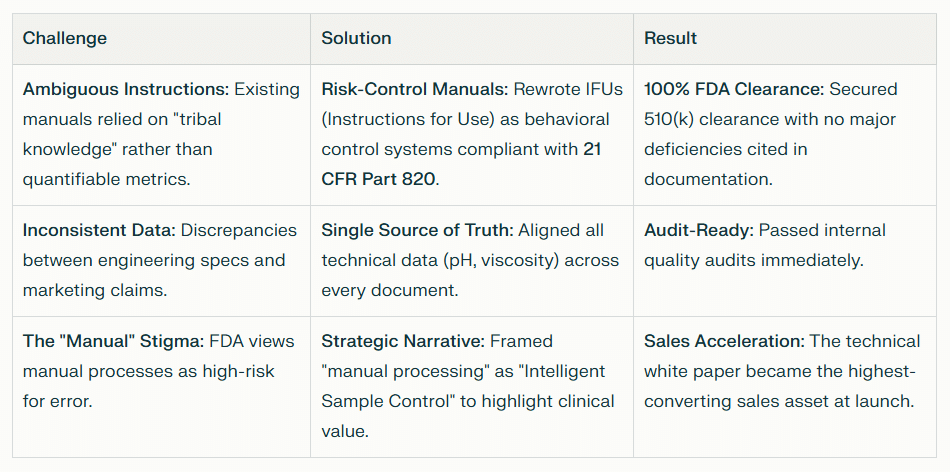
Product Manual Success
Define success in business terms: fewer tickets, faster onboarding, safer use, higher feature adoption.
For many companies, the product manual is the last thing they think about—and the first thing their customers see when something goes wrong. A successful manual does more than “explain the buttons”; it protects your users, reduces support calls, and makes your product feel polished and professional.
At Writing for Results, we specialize in turning confusing, incomplete instructions into clear, user‑friendly manuals that work in print, PDF, and online formats.
Wherever it is warranted, we apply ASD-STE100, an international standard and controlled language, designed to make our technical documentation clear, concise, and unambiguous. We also follow Albert Einstein’s edict that Everything should be as simple as it can be, but not simpler.
Why most manuals fail (and cost you money)
Most manuals fail for the same predictable reasons: they are written too fast, too late, and without the user in mind. The result is dense text, missing steps, and safety information that feels like boilerplate rather than real guidance.
When that happens, customers guess, get frustrated, or give up entirely. They open support tickets, leave negative reviews, or shelve the product because using it feels harder than it should.
ValerieBraun@technicalWritingExpert.com
The Essential Building Blocks of a High‑Performing Product Manual
-
-
-
Product overview and specifications
-
Safety information and warnings
-
Getting started / setup
-
Operating instructions (task‑based, stepwise)
-
Troubleshooting and FAQs
-
Maintenance and care
-
Warranty and support channels
-
-

What makes a product manual exceptional
An exceptional product manual does more than avoid confusion—it actively helps customers feel confident, capable, and supported every time they use your product. It moves beyond “good enough” by being intentional about outcomes, not just information.
You can usually recognize an exceptional manual because it:
-
Centers on user goals, not product features
It’s organized around what people are trying to do (set up, connect, troubleshoot, upgrade), with each section written as a clear task, not a feature dump. -
Gets users to “first success” fast
The early pages focus on safe setup and that first meaningful win with the product, so users feel momentum instead of friction. -
Makes information instantly findable
Headings, page titles, table of contents, and indexing are deliberate, so users can jump straight to the answer—without reading in order. -
Uses language that builds confidence
Sentences are short and direct, jargon is minimized or explained, and every step tells the user exactly what to look for or do next. -
Integrates visuals that truly guide
Diagrams, screenshots, and callouts are tightly aligned with the steps, labeled clearly, and used to remove ambiguity—not just decorate the page. -
Anticipates real‑world problems
Troubleshooting sections are based on actual failure modes and common questions, offering simple checks and clear thresholds for contacting support. -
Is consistent across products and channels
Terminology, style, and structure match across models, PDFs, web help, and in‑app guidance, so users never have to “learn” a new documentation style.
When these elements come together, the manual stops feeling like a separate booklet and starts feeling like a natural extension of the product itself.
Best Practices That Separate Amateur Manuals from Professional Ones
- Audience analysis and purpose definition.
- Clear, scannable layout (headings, lists, white space).
- Consistent terminology and style guide.
- Smart use of visuals (not decorative, but instructional).
- Plan for updates and multi‑channel publishing (PDF, web, in‑app).
Core elements of a successful manual
- Clear Structure: Introduction, Safety, Getting Started, Operating Instructions, Troubleshooting, Maintenance, Warranty and Support.
- Audience‑Appropriate: Language: concise, low‑jargon, task‑oriented.
- Visuals and Formatting: that support scanning and comprehension (diagrams, step lists, consistent headings).
- Compliance‑Aware: safety and regulatory content where needed.
This is exactly the kind of disciplined, user‑focused approach we bring to client manuals at Writing for Results.
How we make your manual exceptional
Once you know what “exceptional” looks like, the question becomes: who can reliably create that level of manual for your product line? That’s where our approach comes in.
Here’s how we make manuals stand out:
- We start with your business and support goals
Before drafting, we clarify what success looks like for you: fewer tickets, safer use, faster onboarding, higher feature adoption, or all of the above. - We map real user journeys and scenarios
We look at how different users actually encounter and use your product—first‑time setup, everyday tasks, edge cases—and structure the manual around those journeys. - We apply a disciplined structure and style guide
Every manual uses a consistent, reusable framework (overview, safety, setup, operation, troubleshooting, maintenance, warranty) plus a defined voice, terminology, and formatting standard. - We design for clarity, not just completeness
We favor concise steps, clear headings, and strategically placed visuals that remove ambiguity—especially around safety, configuration, and troubleshooting. - We build for multi‑channel reuse
From the outset, we plan your content so it can be used in print, PDF, web help, and knowledge bases with minimal rework, keeping future updates efficient and affordable. - We treat your manual as a performance asset
- Our focus is always on measurable impact: fewer “how do I…?” contacts, smoother onboarding, and customers who feel confident using your product without hand‑holding.
The result is a manual that is clearly differentiated from the generic, last‑minute booklets many competitors ship—a manual that reflects the quality of your product and the professionalism of your brand.
Growing Your Product Manual
Whether you need a new manual from scratch or a revision of existing documentation, we can help. Contact us to discuss your project scope, timeline, and deliverables.