Medical device procurement is undergoing a fundamental shift. For decades, hospitals evaluated RFP responses primarily on price — the lowest compliant bid won. That model is breaking down. A growing number of health systems are moving to value-based procurement (VBP), a framework that weighs patient outcomes, long-term cost-effectiveness, clinical evidence, and operational efficiency alongside unit cost.
For MedTech vendors responding to RFPs, this isn’t a minor adjustment. It changes what you write, what you prove, and how you position your solution. If your proposal still leads with price competitiveness, you may be answering yesterday’s question.
The Shift from Cost-Based to Value-Based Procurement
Traditional cost-based procurement (CBP) treats medical devices as commodities. The evaluation centers on unit price, delivery terms, and basic specification compliance. It’s a model designed for efficiency, but it systematically undervalues innovation, clinical outcomes, and total cost of ownership.
What does this mean practically? If you’re responding to a medical device RFP, your proposal needs to tell a value story — not just a price story. Clinical evaluation data, patient experience metrics, and total cost-of-ownership analyses now carry more weight than they did even two years ago.
Value Based Procurement (VBP)
Value-based procurement flips this equation. Under VBP frameworks now being piloted and rolled out — including a national rollout confirmed in the UK for early 2026 — buyers must allocate at least 60% of evaluation scores to value domains and no more than 40% to cost. Those value domains include:
-
Efficiency: Pathway impact, productivity gains, system-wide cost-effectiveness
-
Patient and staff experience: Safety, outcomes, health equity
-
Social value: Sustainability, carbon reduction, local economic benefits
-
Supply chain resilience: Continuity, risk management
-
Specification compliance: Technical and quality standards
Research confirms that shifting to VBP leads to better health outcomes and greater cost-effectiveness in hospitals, while also helping identify innovation opportunities that pure cost-focus misses.
VBP Versus CBP
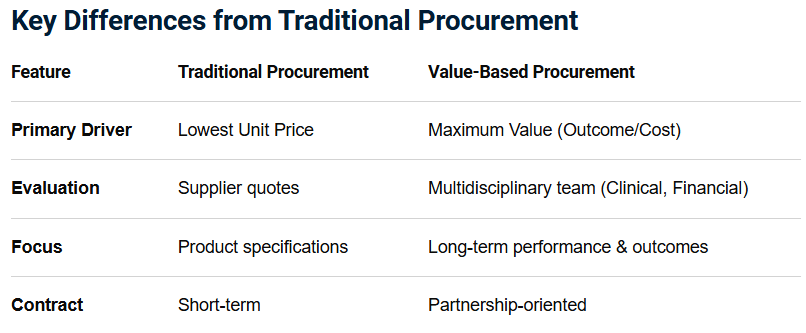
Value-based procurement (VBP) focuses on maximizing patient outcomes, clinical efficiency, and total cost of ownership (TCO) over a product’s lifecycle. In contrast, cost-based procurement prioritizes the lowest upfront purchase price. VBP requires multidisciplinary evaluation, while cost-based prioritizes quick, budget-driven, transactional purchasing.
- Focus: VBP prioritizes health outcomes, patient experience, and total cost of care. CBP focuses strictly on the initial purchase price.
- Decision Drivers: VBP evaluates long-term, system-wide benefits. CBP relies on transactional, lowest-bidder decisions.
- Goal: VBP seeks to improve patient care and reduce total care costs. CBP aims to minimize upfront expenditure.
- Outcome: VBP promotes innovation and better care pathways. CBP can stifle innovation due to intense price pressure.
Key Trends Shaping Medical Device Procurement in 2026
Several converging trends are reshaping the procurement landscape:
Smart, connected devices are the new standard. Medical devices in 2026 are defined by connectivity, AI integration, and patient-centered design. Procurement teams need to evaluate not just the device, but the data ecosystem it creates — interoperability, cybersecurity, and long-term software maintenance.
Regulatory complexity continues to increase. The EU MDR has fundamentally changed how devices are marketed and procured in Europe, with ripple effects on global manufacturers who must now maintain dual compliance pathways. In the U.S., the FDA is emphasizing that software lifecycle documentation, risk management, and post-market monitoring are core quality pillars — yet many MedTech organizations still treat these as afterthoughts rather than design foundations.
Sterilization methods are under scrutiny. Environmental and safety concerns around ethylene oxide (EtO) sterilization are driving hospitals to evaluate alternative methods. Vendors who can demonstrate validated alternative sterilization processes have a procurement advantage.
Quality systems must keep pace with innovation. As AI-enabled and connected devices accelerate, quality management systems that were built for traditional devices are struggling to keep up. Hospitals want assurance that the vendor’s quality infrastructure — from validation to change control — matches the sophistication of the technology being procured.
What This Means for Your Next Medical Device RFP Response
The transition from cost-based to value-based procurement isn’t theoretical — it’s happening now, with formal frameworks being mandated in major markets. For vendors, the implication is clear: winning medical device RFPs in 2026 requires a fundamentally different approach than it did five years ago.
Your proposal needs to:
-
Lead with outcomes, not features — Show how your device improves patient outcomes, reduces total cost of care, and creates operational efficiency
-
Provide clinical evidence and real-world data — Value analysis teams want peer-reviewed evidence, health economics modeling, and pathway analysis
-
Demonstrate regulatory sophistication — Address FDA, HIPAA, EU MDR, and cybersecurity requirements proactively, not as afterthoughts
-
Account for human factors — Show that your device was designed for the people who actually use it
-
Anticipate the full evaluation lifecycle — Plan for lengthy review cycles with multidisciplinary stakeholders
The vendors who win medical device RFPs going forward will be the ones who understand that procurement teams are no longer just buying a device — they’re investing in a value proposition.
Drug-Eluting Stents & Orthopedic Implants: These high-value consumables are frequently targeted for VBP to reduce costs while maintaining quality.
- Imaging Equipment: Evaluating CT or MRI machines based on image quality, scan speed, and energy consumption rather than just the initial price.
- Hospital Value-Based Purchasing (HVBP) Program: CMS adjusts Medicare payments based on quality measures, which influences the types of devices hospitals purchase.
Components of a VBP RFP FOR A MEDICAL DEVICE
A VBP RFP typically shifts from price-only to a weighted evaluation model. Key components include:
- Total Cost of Ownership (TCO): Evaluates purchasing price, maintenance, consumables, training, and disposal.
- Clinical Outcomes: Measures improvement in patient health, reduced hospital stays, or fewer complications.
- Operational Efficiency: Evaluates ease of use, training requirements, and integration with existing IT systems.
- Supplier Partnership: Includes criteria for vendor support, service reliability, and data sharing.
Sample VBP RFP Outline (Medical Device)
- Objective: To procure [Device Name] to improve [Specific Clinical Outcome] while reducing [Cost Factor].
- Scope: Purchase, installation, training, and 5-year maintenance.
2. Value-Based Evaluation Criteria (Total: 100 Points)
- Technical Performance (30 pts): Clinical efficacy, accuracy, reliability, and safety features.
- Total Cost of Ownership (25 pts): Purchase price + 5-year maintenance + consumable cost.
- Patient/Staff Experience (15 pts): Usability, ergonomic design, training time, and user feedback.
- Service & Support (15 pts): Response time, training, and vendor reputation.
- Data & Integration (15 pts): Ability to integrate with Electronic Health Records (EHR).
3. Proposal Requirements
- Provide clinical studies demonstrating improved patient outcomes.
- Detailed breakdown of TCO.
- Case studies of implementation in similar facilities.
4. Performance Guarantees
- Maximum allowable downtime per year.
- Guaranteed accuracy rates
Need help positioning your medical device for value-based procurement RFPs? Whether you’re responding to your first hospital RFP or refining your approach for a major health system acquisition, we bring three decades of RFP strategy, regulatory writing expertise, and technical documentation experience to every engagement.
Whether you’re writing the RFP or responding to one, I bring both perspectives to every engagement — so nothing gets lost between what’s asked and what’s proposed. Book a free consultationand let’s talk about where your process is breaking down and how to fix it.