Navigating Complex RFP Requirements

When an RFP landed for high-performance drone electronic components under solicitation W911S226U2333, TechWing Precision Electronics—a small business specializing in advanced circuit boards and flight controllers for unmanned aerial systems—faced a moment of truth. The Department of Defense sought NDAA-compliant, open-source FPV drone systems, and this $2.5 million opportunity represented more than just revenue—it was validation that their domestic manufacturing capabilities could compete in the evolving defense landscape.

TechWing’s journey through this RFP illuminates the increasingly complex requirements small manufacturers must navigate in 2025 and beyond. The company had to demonstrate compliance with a web of regulatory frameworks that extended far beyond traditional product specifications.

Compliance Layers: More Than Just Specifications

The solicitation explicitly required adherence to multiple regulatory frameworks:

  • Federal Acquisition Regulation (FAR) 19.5 Total Small Business Set-Aside classification

  • 2020 and 2023 National Defense Authorization Acts (NDAA) compliance

  • American Security Drone Act of 2023 prohibitions on foreign entities

  • Federal Acquisition Security Council restrictions on component sources

TechWing’s technical team spent weeks mapping their supply chain across multiple tiers to ensure no components originated from prohibited foreign entities identified by the Federal Acquisition Security Council. They generated comprehensive Software Bills of Materials (SBOMs) for all embedded firmware, following the minimum requirements established by the National Telecommunications and Information Administration and mandated by Executive Order 14028.

Their cybersecurity documentation had to demonstrate Cybersecurity Maturity Model Certification (CMMC) Level 2 compliance—a requirement that became contractually enforceable with the Department of Defense’s final DFARS rule effective November 10, 2025.

Supply Chain Transparency as a Strategic Differentiator

The company’s supply chain transparency efforts proved particularly challenging yet ultimately differentiating. Defense Federal Acquisition Regulation Supplement (DFARS) clauses required TechWing to provide traceability documentation substantiating material sources and technical conformance. They implemented supply chain mapping technologies that tracked components through multiple tiers:

  • Raw materials from approved suppliers

  • Component manufacturing with quality certifications

  • Assembly processes with material documentation

  • Final product testing and validation

  • Post-delivery compliance verification

This comprehensive supply chain illumination, mandated by recent NDAA provisions, transformed from a compliance burden into a competitive advantage. TechWing’s documented traceability demonstrated maturity and risk management that competitors with less rigorous processes could not match.

Cybersecurity and Compliance Commitments

What TechWing discovered was that winning this RFP wasn’t just about building superior drone electronics—it was about demonstrating comprehensive risk management across multiple dimensions. Their response included:

  • Detailed Plans of Action and Milestones (POA&Ms) for continuous CMMC compliance

  • Annual affirmations of cybersecurity posture with third-party verification

  • Integration with the Supplier Performance Risk System (SPRS) for pre-award validation

  • Remote information wipe capabilities meeting federal data protection standards

  • Multifactor authentication systems for all access points

The Office of Management and Budget’s November 2025 memorandum on UAS procurement added additional layers, requiring encryption of mission data both at rest and in transmission, multifactor authentication for system access, and the ability to wipe federal information remotely.

The Award-Six Months of Preparation Pays Off

After six months of preparation and a meticulously crafted 347-page response that addressed every technical, compliance, and business requirement, TechWing received the contract award. Their win rate climbed, their reputation solidified, and they gained invaluable experience navigating the most stringent procurement requirements in federal contracting. Their story exemplifies how small businesses can compete successfully in the government market by understanding and exceeding compliance expectations.


What is an RFP?

A Request for Proposal (RFP) is a formal document issued by government agencies or private organizations seeking specific products or services from external providers. The RFP serves as a cornerstone of transparent procurement, establishing a structured methodology for collecting detailed proposals from vendors, evaluating them against predetermined criteria, and selecting the provider that best meets the issuer’s technical, operational, and financial requirements.

RFPs ensure competitive bidding without favoritism or bias, upholding procurement integrity through standardized evaluation processes. In government contracting, RFPs are legally mandated for most procurement activities, subject to complex regulations including the Federal Acquisition Regulation (FAR) and agency-specific supplements.

Where RFPs Are Used

Federal, state, and local agencies use RFPs for procurements spanning diverse sectors and service categories:

  • Information technology systems and software solutions

  • Professional services (consulting, engineering, legal)

  • Complex equipment acquisitions and hardware

  • Infrastructure projects and construction

  • Maintenance and support services

  • Specialized manufacturing and production

Key RFP Response Elements

The RFP document typically comprises several critical elements:

  • Statement of Work (SOW) or Performance Work Statement (PWS) defining deliverables and objectives

  • Instructions to Offerors explaining submission requirements and formatting

  • Evaluation Criteria outlining how proposals will be scored

  • Budget Constraints or cost parameters

  • Submission Deadlines with associated milestones

  • Contract Line Item Numbers (CLINs) breaking down the contract into specific items with quantities and pricing

  • Terms and Conditions covering compliance with laws, regulations, and special requirements

What is an RFP Response?

An RFP response is a comprehensive proposal document submitted by vendors competing for contract awards, demonstrating how their solution addresses the issuer’s requirements while showcasing qualifications, experience, and unique value propositions. The response serves dual purposes: proving compliance with mandatory requirements and persuading evaluators that the vendor represents the optimal choice among competitors.

Response Structure and Key Sections

Effective RFP responses follow a structured format that mirrors the issuer’s priorities and evaluation criteria:

  • Cover Letter establishing human connection and expressing genuine partnership interest

  • Executive Summary synthesizing crucial proposal aspects without requiring full document review

  • Technical Approach detailing methodologies, processes, and technologies for fulfilling requirements

  • Management Plan articulating project governance, team structure, and communication protocols

  • Past Performance showcasing relevant experience through case studies with quantifiable results

  • Pricing Proposal outlining cost structures with detailed breakdowns

  • Compliance Matrices mapping every requirement to corresponding response sections

Critical Response Requirements

The response must address both functional and non-functional dimensions. Successful proposals balance:

  • Functional requirements: What the system does and specific deliverables

  • Non-functional requirements: How the system performs in terms of security, reliability, scalability, and usability

  • Substantiation: Every claim backed by proof points—metrics, standards certifications, or customer testimonials

  • Transparency: Clear disclosure regarding any limitations or requirements that cannot be fully met

  • Mapping: Direct alignment between RFP specifications and proposed solutions using compliance matrices and tables

What Makes an Exceptional RFP Response?

Exceptional RFP responses transcend mere compliance, transforming technical documentation into compelling narratives that position the vendor as the singular solution to the client’s challenges.

Characteristics of Winning Proposals

Outstanding responses demonstrate several distinguishing features that separate them from competent but forgettable submissions.

Personalization and Context Understanding

Generic, boilerplate content signals disinterest and fails to resonate with evaluation teams. Exceptional responses demonstrate deep understanding of:

  • The issuer’s industry and operational landscape

  • Specific challenges keeping decision-makers engaged

  • Strategic priorities and organizational objectives

  • Regulatory environment and compliance pressures

When evaluators encounter their specific terminology, recognize their unique challenges articulated accurately, and encounter solutions tailored to their context rather than standardized offerings, engagement intensifies and confidence builds.

Win Themes and Strategic Messaging

Win themes—recurring messages that reinforce the vendor’s competitive advantages—must be strategically embedded throughout the proposal. Effective themes directly address the issuer’s hot button issues:

  • For agencies struggling with deadline compliance: Emphasize proven on-time delivery, robust project management, contingency planning

  • For organizations battling budget overruns: Highlight fixed-price options, transparent cost controls, historical performance within constraints

  • For buyers concerned with cybersecurity: Feature CMMC certifications, security architecture expertise, incident response capabilities

  • For clients valuing innovation: Showcase proprietary methodologies, technical breakthroughs, intellectual property

Clarity, Readability, and Visual Communication

Evaluators reviewing dozens or hundreds of proposals appreciate concise, skimmable formatting featuring:

  • Strategic use of headings, subheadings, and bullet points

  • Tables and matrices for complex comparisons

  • Visual elements (charts, diagrams, infographics) transforming text-heavy content

  • Accessible explanations of technical concepts without excessive jargon unless industry-specific terminology adds precision

Proof and Precision

Exceptional responses include specific, measurable outcomes from previous engagements such as:

  • “Implemented cybersecurity framework that achieved CMMC Level 2 certification within four months, enabling client to compete for $50 million in defense contracts”

  • “Reduced project delivery timelines by 35% through proprietary methodology, saving client $2.1 million annually”

  • “Managed supply chain for 47 component suppliers across 12 countries with zero compliance violations”

Supporting elements include:

  • Customer success stories and case studies

  • Independently verifiable references

  • Quantified results providing tangible evidence

  • Performance metrics exceeding industry standards

Addressing Evaluation Criteria Explicitly

Evaluators assign scores according to specific factors detailed in the RFP—technical approach, relevant experience, cost, timeline, innovation. Exceptional responses demonstrate alignment by:

  • Creating evaluation matrices within the proposal itself

  • Mapping each requirement to corresponding response sections

  • Showing where responses meet minimum standards

  • Highlighting areas where proposals exceed expectations

Anticipating and Addressing Concerns

Preemptively addressing potential objections strengthens credibility. Consider these scenarios:

  • Smaller vendor competing against enterprises: Acknowledge size while emphasizing agility, personalized service, and senior-level attention

  • New technology or unproven approach: Provide pilot programs, phased implementations, or warranty guarantees reducing perceived risk

  • Solution requires client resources: Transparently outline requirements while demonstrating facilitation strategies and training support

  • Incumbent competitor advantage: Focus on innovation, cost improvements, and service enhancements differentiated from status quo

How We Can Help

Navigating the complexities of modern RFP responses—whether for federal, state, local government contracts or private sector opportunities—requires specialized expertise, strategic insight, and meticulous attention to detail. Organizations of all sizes face resource constraints, tight deadlines, and the perpetual challenge of standing out in competitive fields where every submission must demonstrate compliance, capability, and compelling value.

Comprehensive RFP Services

Our approach supports businesses through every stage of the proposal lifecycle:

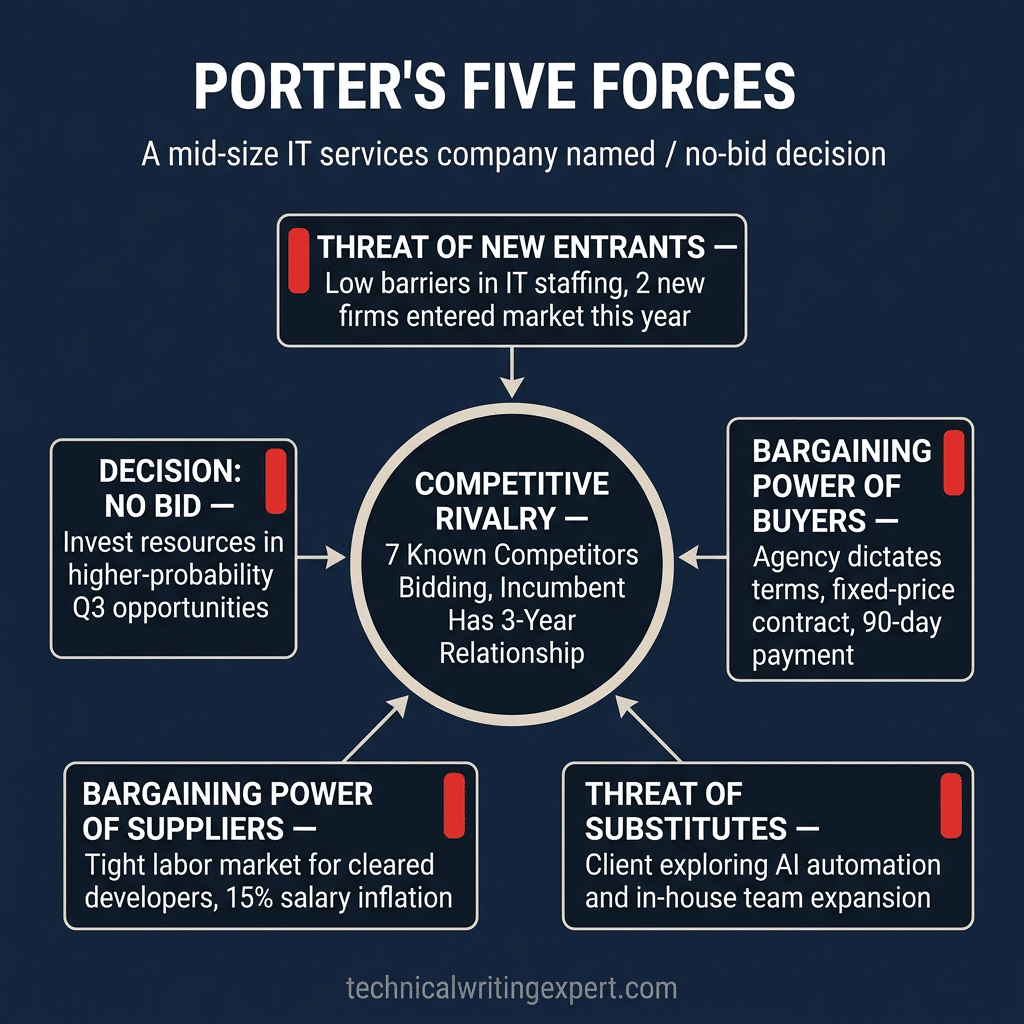
Strategic Qualification and Go/No-Go Analysis

  • Conduct thorough evaluations of opportunity alignment with core competencies

  • Assess competitive positioning and realistic win probabilities

  • Prevent wasted effort on low-probability pursuits

  • Allocate resources strategically to high-opportunity engagements

Detailed RFP Analysis and Compliance

  • Extract every requirement, evaluation criterion, and submission guideline

  • Create comprehensive compliance matrices ensuring nothing falls through the cracks

  • Map technical, management, and cost requirements to your capabilities

  • Identify gaps early and develop persuasive strategies to address them

Narrative Development and Win Themes

  • Craft compelling stories that transform technical specifications into persuasive narratives

  • Develop customized win themes aligned with unique differentiators and client pain points

  • Integrate proof points—quantified outcomes, customer testimonials, certifications, recognition

  • Substantiate claims building evaluator confidence

Regulatory Compliance Expertise

For government contracts, specialized expertise includes:

  • FARS and DFARS compliance assurance

  • CMMC cybersecurity requirements and documentation

  • SBOM (Software Bill of Materials) development and validation

  • Supply chain transparency and traceability demonstration

  • Federal acquisition regulation navigation including FAR Overhaul and class deviations

Project Management and Coordination

  • Manage subject matter expert contributions and scheduling

  • Maintain version control and version history

  • Meet internal and external deadlines reliably

  • Ensure organizational alignment and stakeholder engagement

Technical Proposal Development

  • Develop methodology descriptions addressing each requirement

  • Create realistic implementation plans with detailed timelines

  • Incorporate risk mitigation strategies and quality assurance frameworks

  • Define performance metrics aligned with client objectives

Management and Pricing Proposals

  • Articulate project governance structures and reporting relationships

  • Identify key personnel with roles and qualifications

  • Describe communication protocols and escalation procedures

  • Develop competitive, well-justified cost structures strategically positioned for value

Quality Control and Pre-Submission Review

  • Conduct rigorous compliance checks using detailed checklists

  • Verify formatting requirements, required forms, and submission specifications

  • Perform red team reviews from the buyer’s perspective

  • Identify weaknesses and improvement opportunities before submission

Scalable Engagement Models

We serve organizations across the size spectrum:

  • Small businesses competing for their first government contracts

  • Established enterprises pursuing nine-figure procurements

  • Mid-market companies scaling proposal capabilities

  • Specialized service providers addressing niche markets

Our scalable approach adapts to your resources, timeline, and complexity while maintaining uncompromising quality standards.

Engagement Options

Full-Service Proposal Development
Complete management from analysis through submission

Targeted Support for Specific Sections
Focused assistance on technical approach, management plan, or pricing

Compliance Reviews
Specialized assessment against RFP requirements and regulatory standards

Strategic Coaching
Training and guidance for internal teams to build proposal capabilities

Our mission is singular: helping you win by transforming RFP requirements into winning proposals that showcase your capabilities, address evaluator priorities, and position your organization as the optimal choice.

Ready to Win Your Next RFP?

Don’t navigate complex procurement requirements alone. Whether you’re a small business pursuing your first government contract or an established enterprise competing for major awards, we provide the expertise, strategic insight, and meticulous execution that turn opportunities into wins.

Contact Us Today


RFE Request and Proposal

RFP Request for Proposal

Regional Healthcare Network (RHN) sought to bridge healthcare gaps in rural and underserved communities through a secure, scalable telemedicine platform. 

Company: ABC Telemobile Solutions, LLC
Industry: Telemedicine Software & Support
Client: Regional Healthcare Network (RHN)
Project: Implementation of a comprehensive telemedicine platform with ongoing support services
RFP Issuer: RHN, seeking to expand virtual care to rural and underserved communities

RFP Objectives and Scope
RHN issued an RFP to identify a vendor capable of providing a secure, scalable, and user-friendly telemedicine platform. The RFP emphasized:

  • Virtual consultations (video, phone, and chat)
  • EHR integration
  • HIPAA compliance
  • Mobile access for patients and providers
  • 24/7 technical and clinical support
  • Data analytics and reporting features
  • Training for clinical staff and administrators
  • Cost-effective implementation and support

The RFP also required detailed implementation timelines, budget transparency, and a clear plan for stakeholder engagement and future scalability

RFP Proposal

Background

ABC Telemobile Solutions recognized a strong alignment between RHN’s mission and their core competencies. The team has a proven track record of delivering state-of-the-art telemedicine platforms that prioritize accessibility, security, and compliance-key requirements highlighted in RHN’s RFP. They were particularly drawn to this opportunity because:


  • Commitment to Rural and Underserved Communities: Their solutions are specifically designed to overcome barriers such as limited broadband and healthcare “deserts,” leveraging mobile-first technology and intelligent diagnostics to extend quality care where it’s needed most.
  • Regulatory Expertise: RHN’s emphasis on HIPAA compliance, end-to-end encryption, secure authentication, and seamless EHR integration directly matched their experience implementing platforms that meet or exceed these standards for healthcare clients nationwide.
  • Comprehensive Support and Training: The RFP’s requirement for robust patient education, technical support, and pilot testing aligns with their established processes, which include hands-on training, 24/7 support, and iterative feedback collection to ensure smooth adoption and continuous improvement.
  • Innovation in Healthcare Delivery: As a company at the forefront of telehealth, artificial intelligence, and IoT integration, ABC is uniquely positioned to deliver scalable, future-ready solutions that not only meet today’s needs but also adapt to tomorrow’s challenges.
  • Shared Vision for Equitable Care: They are motivated by RHN’s vision to reduce disparities in healthcare access and outcomes. Their experience in deploying telemedicine in similar regions has resulted in measurable improvements in patient satisfaction, reduced missed appointments, and enhanced provider efficiency.

Given RHN’s focus on compliance, patient engagement, and measurable outcomes, ABC Telemobile Solutions saw this RFP as an ideal opportunity to demonstrate their commitment to innovation, equity, and partnership.

An RFP Proposal

ABC Telemobile Solutions, LLC, a certified small business with a 92% RFP win rate, presented a tailored solution designed to meet RHN’s objectives of expanding access, ensuring regulatory compliance, and delivering measurable value.

ABC Telemobile combines regulatory mastery, cutting-edge technology, and a patient-first ethos to deliver a telemedicine platform that grows with RHN’s mission. Their proposal included a dedicated project manager, quarterly ROI reports, and optional on-site training-ensuring a partnership that extends beyond implementation.

RFP, request for proposal, request for proposals, RFP resonses, FDA submissions, ecta, FARS. DFARS EMA guidelines, SAM.gov workflows, HIPAA compliant manuals, user guides, safety protocols, NDA, ANDA, SF330

ABC’s RFP Proposal Approach

1. Understanding Client Needs
ABC began by thoroughly analyzing RHN’s objectives, engaging with key stakeholders (including clinicians, IT, and patient representatives) to clarify pain points and success metrics.

The team identified RHN’s priorities: expanding rural access, ensuring regulatory compliance, and minimizing disruption during rollout.

2. Tailored Solution Design
They proposed a modular telemedicine solution:

  • Secure Video and Messaging: End-to-end encrypted video consultations and secure messaging, compliant with HIPAA and state privacy laws.
  • Seamless EHR Integration: API-based integration with RHN’s existing EHR, ensuring continuity of care and reducing manual data entry.
  • Mobile App: Custom-branded patient and provider apps for iOS and Android, supporting remote monitoring and appointment scheduling.
  • Data Analytics: Real-time dashboards for utilization, patient satisfaction, and clinical outcomes.
  • 24/7 Support: Dedicated helpdesk and clinical support, with guaranteed response times under 30 minutes.

3. Compliance and Quality Assurance
They highlighted its track record of 100% HIPAA compliance across all deployments. The proposal included:

  • Regular security audits and penetration testing
  • Staff training modules on privacy and data handling

4. Implementation and Training Plan
The proposal detailed a phased rollout:

  • Phase 1: Pilot in two rural clinics (Month one to two)
  • Phase 2: Network-wide deployment (Month three to six)
  • Phase 3: Ongoing optimization and quarterly reviews

5. Budget and Value Proposition
ABC provided a transparent, itemized budget, aligning with RHN’s financial projections. The proposal demonstrated cost savings through reduced travel, improved appointment adherence, and scalable pricing as usage grew.

6. Dynamic Visuals and Accessibility
The proposal featured:

  • Interactive Gantt charts for the implementation timeline
  • Infographics illustrating patient journey and technical workflows

Our Role In This Project

  • Proposal strategy and RFP proposal creation.
  • Operational requirements and process flows
  • Drafted entire proposal in mutually agreed upon format.
  • Aligned language with 45 CFR §164.308–§164.312 requirements (encryption, breach protocols).
  • Translated SMB inputs into clear, jargon-free explanations.*
  • Curated client success stories with metrics.
  • Created all graphics used in the proposal.
  • Packaged proposal per instructions.
  • Submitted proposal as per RFP instructions.
  • Monitored RFP proposal through the award.

*We are Simplified Technical English and Plain English experts so we are able to do this with any of the documentation we create.

We are experts for the full RFP lifecycle:  RFP Development to RFP Proposal

Compliant RFP Gap Analysis

Our signature gap analysis for new RFPs and new RFP proposals combines strategic alignment, regulatory compliance,  and risk management.  This ensures that your RFPs or RFP proposals are compliant, competitive, and tailored to client priorities.

The analysis includes such assessments and methodologies as  requirement mapping, predictive analytics for risk mitigation, and compliance and regulatory alignment.  These analyses are industry-specific. 

Get a Free Compliant RFP Gap Analysis

GET STARTED NOW

Highlights of ABC’s Proposal

1. Secure, Patient-Centric Platform

  • End-to-end encryption aligned with HIPAA §164.312 and state privacy laws.
  • Mobile-first design: Custom-branded iOS/Android apps for providers and patients, enabling appointment scheduling, prescription renewals, and remote vital monitoring.

2. Interoperability and Analytics

  • EHR integration: API-based connectivity with RHN’s existing systems, reducing duplicate data entry by 40%.
  • Real-time dashboards: Track utilization rates, patient satisfaction (98% in pilot clinics), and clinical outcomes.

3. Phased Implementation Minimizing Disruption

  • Phase 1 (Months 1–2): Pilot launch in two rural clinics, including staff training and patient onboarding
  • Phase 2 (Months 3–6): Full network rollout with continuous optimization.
  • Phase 3 (Ongoing): Quarterly reviews to refine workflows and expand features.

4. Unmatched Support and Compliance

  • 24/7 helpdesk: <30-minute response time for technical/clinical issues.
  • Audit readiness: Zero compliance incidents in 18+ months across deployments.

Why ABC Telemobile?

  • Small Business Agility: Faster decision-making and personalized service vs. larger competitors.
  • Proven Expertise: 100% HIPAA compliance across 50+ deployments, including a $8M telemedicine contract with zero audit findings.
  • Cost Transparency: Tiered pricing model ensures affordability, with 20% reduced missed appointments driving long-term savings.

Proven Results

  • 98% patient satisfaction in rural pilot clinics.20% reduction in missed appointments via automated reminders and mobile access.
  • Zero HIPAA violations post-implementation.

ABC Telemobile offered regulatory mastery, cutting-edge technology, and a patient-first ethos to deliver a telemedicine platform that grows with RHN’s mission.  The proposal included a dedicated project manager, quarterly ROI reports, and optional onsite training,ensuring a partnership that extends beyond implementation.

Outcome

RHN shortlisted ABC and two larger competitors. ABC Telemobile was awarded the contract based on its clear understanding of RHN’s needs, cost-effective and compliant solution, and commitment to ongoing partnership.

Lessons Learned and Best Practices

  • Clarity and Detail: ABC Telemobile’s proposal stood out for its clear objectives, detailed technical requirements, and transparent budgeting-addressing common RFP pitfalls like vague requirements or hidden costs.
  • Stakeholder Engagement: Early and ongoing communication with RHN’s stakeholders ensured the solution fit real-world workflows.
  • Regulatory Compliance: Demonstrating a robust compliance framework (including regular audits) built trust and reduced risk for RHN.
  • Visual Communication: Accessible, dynamic visuals made complex information easy to digest for evaluators with diverse backgrounds.
A compelling, detailed RFP proposal for this small business not only validated their expertise but also reassured evaluators of their readiness to deliver high-quality, compliant, and sustainable telemedicine solutions.

Get In Touch

Affordable, results-oriented RFPs and RFP proposals.

CONTACT US