It is easy to say yes to every promising RFP. It is much harder to admit that some opportunities are unwinnable or strategically unwise, no matter how shiny they look. Porter’s Five Forces gives you a practical way to make that call before you commit weeks of work.
You do not need a strategy workshop to use it. You need a clear view of five forces and the courage to walk away when the picture is wrong for you.
I can create a simple, reusable tool that is a practical go/no‑go framework based on Porter’s Five Forces–one that your sales and proposal teams will actually use.
A quick refresher on Porter’s Five Forces
Porter’s Five Forces is a framework for understanding how attractive a market or opportunity is. It looks at:
-
Rivalry among existing competitors.
-
Threat of new entrants.
-
Threat of substitutes.
-
Bargaining power of buyers.
-
Bargaining power of suppliers.
In the RFP world, this translates directly into how hard it will be to win and how profitable the work will be if you do.
Force 1: Rivalry – how crowded is this bid?
Some RFPs quietly favor an incumbent. Others go to open market and attract ten or more vendors. The more intense the rivalry, the more you need a clear edge. Ask yourself:
-
Are we the incumbent or a credible challenger?
-
Do we stand out meaningfully on capability, approach, or relationship?
-
Is the buyer mostly comparing on price?
High rivalry plus no clear differentiator is a warning sign.
Porter’s Five Forces and Apex Solutions
Using Porter’s Five Forces to Decide Which RFPs Are Worth Your Time
Apex Solutions almost wasted $47,000 and six weeks chasing an RFP they were never going to win.
They’re a mid-size IT services firm — 120 employees, solid past performance, reliable delivery. When a federal agency posted a $4.2M IT staffing and development contract, their BD team’s instinct was “absolutely bid.”
Then their proposal director ran a Porter’s Five Forces analysis on the opportunity:
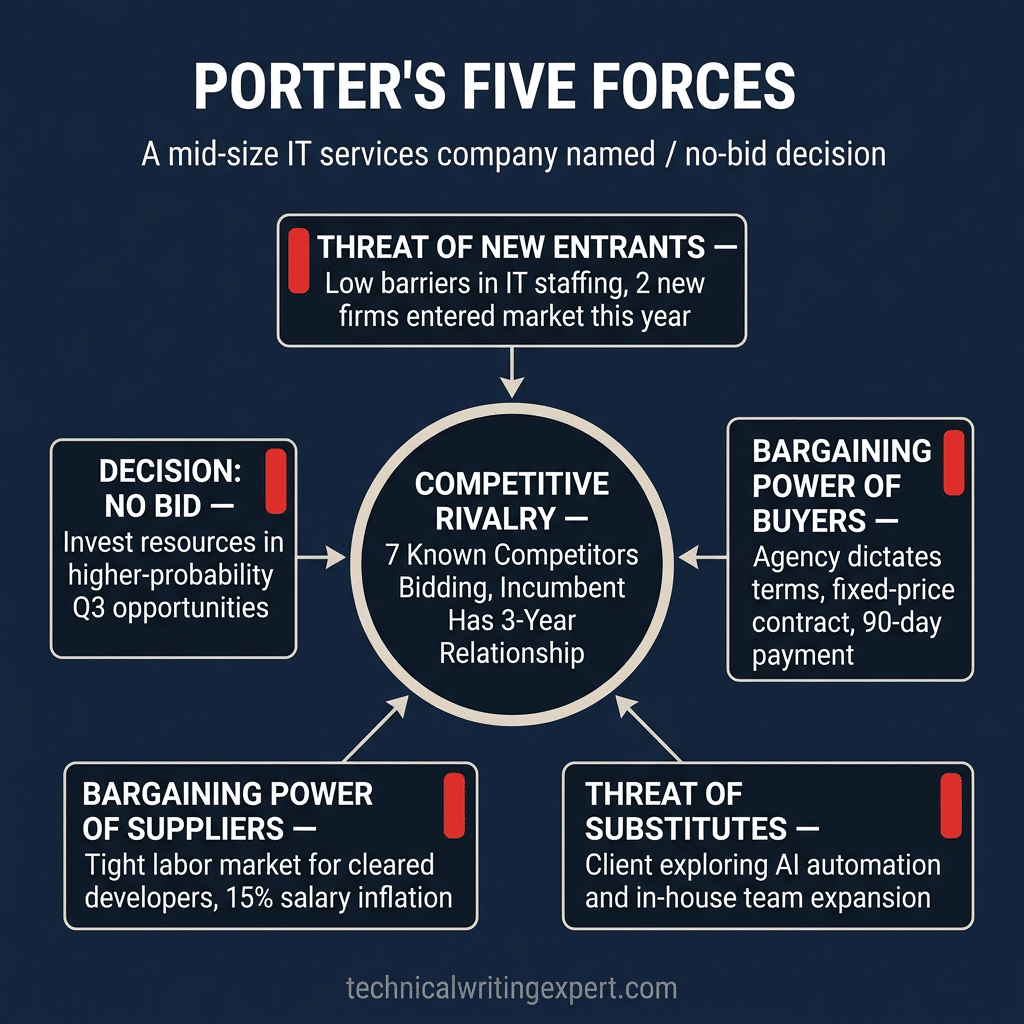
Competitive Rivalry — Seven known competitors were bidding. The incumbent had a three-year relationship with the client and inside knowledge of their systems. Apex had zero prior contact with the agency.
Threat of New Entrants — Two new firms had entered this market segment in the past year alone, each undercutting on price to build past performance. Low barriers meant more crowding, not less.
Bargaining Power of Buyers — The agency dictated every term: fixed-price contract, 90-day payment windows, and a rigid evaluation rubric that heavily weighted past performance with their specific office.
Bargaining Power of Suppliers — The cleared developer market was extremely tight, with 15% salary inflation year-over-year. Apex would need to recruit new talent just to staff this contract — adding risk and cost.
Threat of Substitutes — The agency was simultaneously exploring AI-driven automation tools and expanding their in-house development team. Even if Apex won, the contract scope could shrink mid-performance.
The Decision: No Bid.
Not because Apex couldn’t do the work — but because every force was working against them. They redirected those six weeks and that $47,000 in proposal costs toward two Q3 opportunities where they had existing relationships, strong past performance, and favorable contract terms.
They won both.
Most proposal teams treat every RFP like a must-bid. The ones who win consistently are the ones who know when to walk away — and have a framework for making that call.
Force 2: Threat of new entrants – will this market keep filling up?
If an RFP sits in a market that is easy to enter, you may win once and then fight off low‑cost competitors every renewal. Look for clues:
-
Low regulatory or technical barriers to entry.
-
Buyers who routinely “refresh the market” to chase lower prices.
-
Minimal onboarding or integration cost for new vendors.
When the door is wide open, you need a plan to defend your position after you win.
Force 3: Threat of substitutes – are there simpler alternatives?
Sometimes the real competitor is not another vendor; it is a different way to solve the problem. Ask:
-
Could the buyer solve this internally with a process change or small tool?
-
Are they testing the market while leaning toward a different model?
-
Does their scope read like they are unsure what they really want?
If substitutes are strong, the project may shrink, stall, or disappear after award.
Force 4: Buyer power – who really holds the leverage?
Some buyers are highly constrained and will work with you as a partner. Others have many credible options and will use that to push price and terms. Signals of high buyer power:
-
Many qualified vendors in your space.
-
Very prescriptive terms and conditions with little room to negotiate
-
Heavy focus on discounts and price breakdowns.
High buyer power is not always bad, but it should inform how much effort you invest and how you price risk.
Force 5: Supplier power – what will it cost you to deliver?
On your side, supplier power shows up in your cost base and capacity. Consider:
- Do you rely on scarce specialists or external partners?
- Are input costs volatile, with little room to adjust pricing later?
- Will this project tie up resources you need for more strategic work?
Winning an RFP that strains your supply side can hurt more than losing.
Turning the Five Forces into a go/no‑go decision
You do not need perfect data. You need a simple, repeatable conversation. For each RFP:
- Score each force as Low, Medium, or High risk for you.
- Note 1–2 reasons behind each score.
- Decide whether the overall picture is Attractive, Marginal, or Unattractive.
Then pair that with your fit: domain expertise, references, solution strength, and relationship access.
-
Attractive forces + strong fit: lean in and invest.
-
Marginal forces + strong fit: proceed, but manage expectations.
-
Unattractive forces + weak fit: politely decline.
Why this matters for your RFP team
You do not need perfect data. You need a simple, repeatable conversation. For each RFP:
-
Your team spends more time on winnable work.
-
Leaders see a clearer link between opportunity selection and win rate.
-
You stop chasing volume and start pursuing strategic, profitable deals.
You still will not be able to predict every outcome. But you will stop treating all RFPs as equal, and that alone can transform your pipeline.
Not sure Which RFPs Deserve Your Team’s Time?
I help organizations build practical, repeatable go/no‑go frameworks — grounded in competitive analysis — so your proposal team focuses on bids you can actually win. Send is your RFP so that we can talk through your current pipeline.